
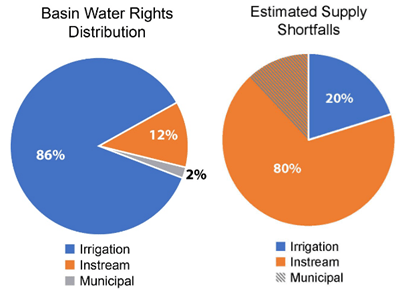
Source: Upper Deschutes River Basin Study Final Report, US Bureau of Reclamation and Oregon Water Resources Department, October 2019.
Now that we are most likely entering a period of severe drought (see this post for the latest thinking on this from the Oregon Water Resources Department) it’s time to revisit how water is used in Central Oregon (Deschutes, Jefferson, and Crook counties). A note on the title of this post: all water in our state is the property of the citizens of Oregon. Rights are granted for the use of that water with the stipulation that the water be used “beneficially” and “without waste”. In my opinion, these terms are not enforced with any reasonable interpretation of those provisions.
I periodically write about the use of water by irrigators based on US Department of Agriculture data, see this post for the latest on that topic. I don’t want to restate my previous posts on the USDA data, you can read the unsettling details for yourself, but the summary is that while the irrigation districts control 86% of all the water rights in the Upper Deschutes Basin, less than half the farms as defined by the USDA had gross incomes (revenues) exceeding $10,000 a year. (A more complete analysis of this can be found here.)
Doing something that generates gross income of less than $10,000 a year is not sustainable primary employment. It’s a hobby. Clearly, everyone has a right to the hobby of their choice, but we taxpayers are subsidizing the irrigation districts with hundreds of millions of dollars.
I don’t want to pick on any one irrigation district, but I will use Central Oregon Irrigation District as an example for a deeper dive. COID is the largest Central Oregon irrigation district in terms of “patrons” which is the term for water right holders in irrigation districts. COID has 3,533 patrons on 4,512 tax lots. Some patrons have multiple lots, each with their own water right. The smallest patrons have a right to 0.1 acres of water, the largest has 940.39 acres of water rights spread over multiple lots. 232 of the 3,533 patrons have mailing addresses outside of Central Oregon ranging from Hawaii to Alaska to the East Coast.
| Acreage | Number of patrons | Percent of total |
| Less than 1 acre | 795 | 22.50% |
| >1 and less than 5 acres | 1,451 | 41.07% |
| >5 and less than 10 acres | 491 | 13.90% |
| >10 and less than 20 acres | 301 | 8.52% |
| >20 and less than 50 acres | 331 | 9.37% |
| >than 50 acres | 164 | 4.64% |
You can draw your own conclusions from the table above. What strikes me is the percentage of patrons on small acreage. 63.57% of COID’s patrons have less than 5 acres of water rights. While there are economically viable farms in COID, overall it is a myth that COID patrons are using water to benefit the public, which was the purpose of granting the rights over 100 years ago. COID is not unique in this regard.
This is important for two reasons. Primarily, there is the obvious tension between using water to benefit the public and resulting ecosystem damage. Public benefit comes from providing economically viable agricultural activity which is frequently not occurring.
At the same time ecosystem damage is undeniable. Rivers are being diverted onto the high desert, reducing historical habit for aquatic, terrestrial, and avian species. The Deschutes Basin Habitat Conservation Plan may eventually address some of the ecological damage, but the DBHCP primarily applies to the Upper Deschutes River above the irrigation withdrawals in Bend. The river continues 170 miles below Bend and will not benefit from the DBHCP.
The second issue has to do with groundwater. Central Oregon’s economy has radically transformed over the past 100 years. Timber and subsistence agriculture are no longer our primary economic sectors. We are now living in a lifestyle economy. Tourism and recreation have generated a huge influx of visitors, new residents, and economic growth. Supplying water to this economy is critically important but is under threat due to decreasing groundwater supplies.
Here is a chart from a recent presentation by OWRD to the Deschutes Board of County Commissioners. It depicts groundwater levels as measured in several test wells. While some stability exists in wells close to the Cascade Mountains there are alarming decreases in the aquifer further away from the Cascades.
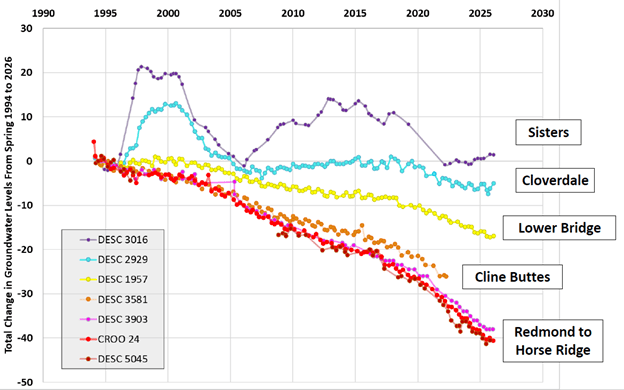
Source: Joe Kemper, OWRD presentation to Deschutes County Board of County Commissioners on 3/2/2026.
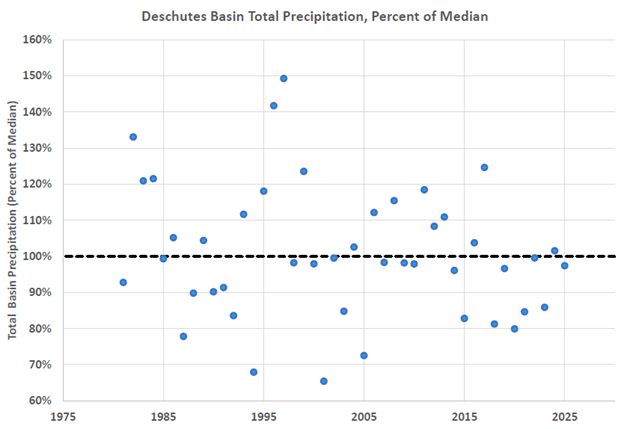
Source: Joe Kemper, OWRD presentation to Deschutes County Board of County Commissioners on 3/2/2026.
The dominant reason for these declines is global warming. The past 30 years have seen periods of good precipitation, but most years have been below average. This is especially true since 2014. Even last year’s often heralded snowpack was barely above average. Central Oregon has limited tools to slow global warming but we should be managing our resources for the future that is clearly in view and racing towards us.
Central Oregon is suffering from water right allocation decisions made over 100 years ago when the state was encouraging pioneer families to come west. Today, the most beneficial use of water has changed significantly. We should now be directing water resources to economically productive agriculture, increasing surface flows to benefit our dominant lifestyle economy, and groundwater recharge for domestic and industrial uses. It’s past time for fundamental change in water management. Unfortunately, our elected representatives are not taking on this challenge.
 Central Oregon Informed Angler