
A few days ago I mentioned two articles posted by Oregon Public Broadcasting discussing irrigator water use in Central Oregon. OPB has now posted a podcast which covers some additional information which I thought was well done. ProPublica has also published the reporting. One of the claims made is that only 26% of water diverted by Central Oregon Irrigation District out of the Deschutes River was used by crops, the rest was lost to seepage and runoff at the end of canals. This figure was disputed by COID but the 26% figure seems to be well supported by the data. There were a few things I wish the reporting had included, but overall I appreciate the work done. I think it would be helpful for folks who have not spent years studying the use of irrigation water to understand the water delivery system. Keep reading for that and a little commentary.
Irrigation districts divert water out of the Upper Deschutes in and upstream from Bend significantly reducing the Middle Deschutes during irrigation season. It is acknowledged that approximately 50% of the water diverted into canals is lost to seepage. The water from the main canals is diverted into “lateral” canals which are used to deliver water to patrons (individual irrigators who are part of the irrigation district). Lateral canals are a combination of district and privately owned. Lateral canals are dug in the same porous lava rock as the main canals and similarly experience significant loss.
COID owns about 89 miles of main canals and about 311 miles of laterals for a total of about 400 miles (another source says the total is 370 miles). There are another 250 miles of private laterals. Once water is delivered to a patron from a lateral canal it may be directly applied to the land using flood irrigation or it may be stored in an irrigation pond for later application via a sprinkler system. It is estimated that there are 2,300 holding ponds in COID.
Using nationwide statistics, flood irrigation has approximately 45% efficiency, meaning that 55% of the water is lost to runoff or to seepage beyond the roots of the plants being watered. COID reports that 27% their patrons use flood irrigation, the article states more than a third of the patrons use flood irrigation.
Traditional sprinkler systems are are also inefficient with about 35% of the water being applied lost in the air before reaching the ground. This is also a nationwide average and loss is higher in dry and windy environments like Central Oregon. Pivot systems deliver water much closer to the ground have higher efficiency rates, but these are primarily used in large scale commercial farms.
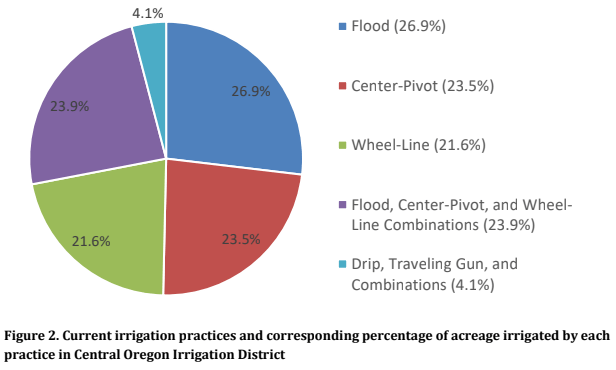
Source: COID On-Farm Water Conservation Report
Evaporation in canals and irrigation ponds is estimated to be a minor part of the losses but end canal spills need to be considered. To meet water deliveries to the last patron on a lateral there has to be enough water at the end of the canal. This includes the water that fulfills the patron’s water right and the “carry water” needed to be present to deliver the water in the water right. This leads to an excess of water at the end of the canal. This excess water is either taken by the last patron or spilled out the end of the canal. End canal spills are common.
The OPB article states that “water experts” claim that excess water applied to a field or spilled out the end of a lateral canal is not an issue as it flows back into a river (the Deschutes or Crooked) or seeps into the ground and recharges the aquifer. From an ecological perspective, this is nonsense.
I have seen end spills flow directly into the Deschutes. These spills are warm water polluted by animal waste and runoff into the canals that degrade the river. Further, I have repeatedly asked the Oregon Water Resources Department for data confirming that excess water returns to the aquifer and they have never responded. I would love to see data that in our dry climate, with very low soil moisture, recharge from overwatering fields returns to an aquifer that is thousands of feet below where the water is applied. Sure, recharge can occur from recharge ponds where the soil is constantly saturated, but where’s the study confirming it occurs from fields?
Even if some amount of recharge does occur, the water will return to the Deschutes River near Lake Billy Chinook where the aquifer and the river meet. This may be helpful for the Lower Deschutes but it does not help the long stretch from Bend, where the water is diverted, to Lake Billy Chinook. This stretch is the Middle Deschutes, which is in very bad shape, and the Deschutes Basin Habitat Conservation Plan has no provision for increasing flows in this stretch.
My last comment has to do with waste. How is this incredibly inefficient use of water not considered waste? One of the very first articles I wrote on this topic many years ago questioned what I consider to be the lack of enforcement of the waste provision in water rights in Central Oregon. If district patrons are “farms” then they are businesses. Businesses have the obligation of maintaining their operations to remain competitive and adhere to changing environmental regulations or cease operations. Why have the irrigators largely not updated their practices over the past 100+ years and why are we taxpayers now on the hook to pay for those improvements, especially when the majority of the water diverted out of the river is not being used in an economically beneficial manner? It boggles my mind. Sure, we should be working to get water to economically productive farms, but the current plan is not focused on that.

