
As you already know, low steelhead returns have closed the Deschutes River to anadromous fishing for the rest of the year. Last week I read a headline stating that the fewest summer steelhead have passed through Bonneville Dam since counting first started in 1938. Earlier in the year, spring chinook returns in the Columbia River were also quite low. At the same time, fall chinook numbers are increasing and coho numbers are exploding in the Deschutes. What’s going on? (For a good overview of historical returns to the Deschutes, see this presentation from the Deschutes Fisheries Workshop this past July. Here’s more on spring chinook in the Deschutes, it’s pretty bleak.)
Sidebar: I really wrote this post as a research project for myself as a way to organize some thoughts. Perhaps you will get something out of it as well. If you have some comments or I have made mistakes, let me know.
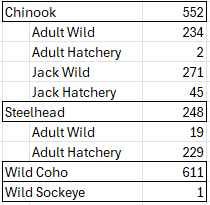
The table above shows counts at the Sherars Falls trap on the Deschutes from July 2 through September 21 of this year when I started writing this post. There are a few things to be be aware of with this data. The trap only captures about 10% (+/- 1% – 2%) of the fish moving up the river, so add a 0 to the end of each number for a rough estimate of the total number of fish in the river above the falls as of September 21. So, roughly 6,110 coho have already moved past Sherars Falls, but it’s still very early for them. The first fish was captured on August 24th and numbers have been increasing since then.
Why are there such large differences between the success of these different anadromous species in the Deschutes? Clearly, this is an extremely complex topic, but there are some high level themes. (See this post as well.)
In 2020 a paper titled “A synthesis of the coast‐wide decline in survival of West Coast Chinook Salmon” was published in the Fish and Fisheries journal. At the time it created an uproar in parts of the environmental community, including objections from many prominent fish conservation groups, who have built their identities around the problems caused by one or more of the “4 Hs”: habitat, hydropower, harvest, and hatcheries.
The scientific community generally agrees that habitat degradation, dams, unsustainable harvest, and hatchery fish are important factors in the decline of many anadromous stocks. But, as the paper pointed out, and which I have been writing about since 2018, there is a 5th “H” that is now the most important one: heat. At the time, I received criticism from various fish conservation groups for defending the 2020 paper.
I don’t know if these groups had not accepted the fact that global warming is disrupting freshwater and marine conditions. Or perhaps they felt threatened when their mission, be it habitat restoration, dam removal, hatchery reform, etc., was somehow undermined by the addition of a new threat. So much for some groups being guided by science.
The science shows that anadromous species are impacted by all 5 Hs. The traditionally cited causes for population declines certainly remain valid. Spring chinook and summer steelhead enter freshwater systems early in the year and seek cool, frequently higher elevation waters to wait out the summer before spawning in the fall. Those traditional spawning grounds are now often blocked and turned into reservoirs by dams. If not blocked, global warming has reduced flows and heated what were previously optimal spawning waters. Fall chinook enter after the heat of summer has passed and spend much shorter time in freshwater, spawning at lower elevations. Additionally, spring chinook and summer steelhead juveniles spend a year or longer in freshwater while fall chinook juveniles out migrate within months of hatching.
Ocean conditions also play a significant and complex role. Anadromous species follow different migration patterns, encountering different marine environments and food webs. Some fish stay closer to shore, some travel far north, some go as far west as Kamchatka. Some stay at shallower depths, some at deeper. Marine heat waves at different depths and locations have varying impacts on food sources. There is also increased competition from huge hatchery production of pink and chum salmon in Alaska, Russia, and Japan.
For whatever set of reasons in this complex environment, in many places fall chinook and coho are proving to be more resilient than steelhead and spring chinook. The oddity is the explosion in coho.
Coho do not appear in any historical records of Deschutes fish populations. The Oregon Department of Fish & Wildlife first saw them in the Deschutes in 2005. Their population has exploded since then. Paradoxically, like steelhead and spring chinook, coho are also tributary spawners and seem to have found habitat that steelhead and spring chinook cannot use. Like Deschutes steelhead, coho spawn in the late fall and winter, rear for at least a year in freshwater, and then spend two years in the ocean.
It is unknown why coho are growing in abundance, and expanding into new locations, in the Pacific Northwest. Habitat improvement could play a role, but there has been no important habitat improvement in the Lower Deschutes Basin. In fact, coho are spawning in areas which have seen declining conditions that were previously used by spring chinook. These areas have seen a significant reduction in spring chinook redds but coho are thriving there. Coho are also spawning in tributaries where steelhead are not present.
Habitat improvements, dam removal, hatchery reform, and careful harvest management are important and should be advocated for, but we need to acknowledge that some anadromous fish are simply better suited for a hotter world. This raises a host of interesting management questions but this post is already too long.

