
Prior to the removal of the four dams on the Klamath River in 2024 I would take a couple of multi day trips every winter to fish for steelhead in the stretch below Iron Gate down to Happy Camp. These were fun, productive excursions and it’s fun to fish from a boat. It’s the third winter since dam removal so I thought it was time to get back on the river and see it for myself. We are all familiar with the positive stories of salmon making their way past the dams and up into the Upper Klamath Basin, but this trip illustrated how damaged the river below the dams remains.
Read More »Category: Klamath Basin
Salmon in the Upper Klamath Basin
This morning’s ODFW commission meeting included a presentation on chinook passage above the recently removed dams on the Klamath River. In short, passage has been fantastic and more than surprising. It is worth watching the recording which starts around 54:24 and lasts about 28 minutes. If you want to see the presentation in a bigger window, go to YouTube and search on ODFW commission meetings.
Salmon in the Upper Klamath Basin
Readers of this blog have probably already seen the reports that chinook are now in the Upper Klamath Basin. If not, here’s the ODFW press release and here’s a story on OPB. Clearly, this is fantastic news. I have closely tracked the dam removal efforts for many years and am happy that I was able to play a very, very small part in this when I was on the ODFW Restoration and Enhancement Board where we toured the J.C. Boyle Dam when removal was not certain and allocated funds for an important scientific study and future restoration work. It was a tiny part of a far larger effort, but every little bit mattered in early on. There’s much remaining to be done, especially upgrading the ladder at the Keno Dam, but good news like this is more than welcome these days.
The DRA is right on this one, plus a comment about Klamath River Dam removal
As readers of this blog know, I am a frequent critic of the Deschutes River Alliance. But, I have to acknowledge the extremely rare occurrence of the DRA getting something correct. As they point out in their latest blog post, Portland General Electric has changed the way in which they report steelhead returns. PGE no longer differentiates between natural origin steelhead and hatchery stock passed above the Pelton Round Butte project. As I wrote about last May, it is disingenuous for PGE to lump these together when reporting total steelhead returns. There is a huge difference between returning fish that were naturally spawned in the Upper Deschutes Basin and those spawned in a hatchery.
Read More »Spencer Creek video
I acknowledge that I been posting a lot about Klamath Basin stuff lately, but I recently came across this short video of salmon spawning in Spencer Creek. It’s so great to see. Spencer Creek is in Oregon, it meets the Klamath River just above where the J.C. Boyle Dam used to be, a little below Keno. I have been told that hundreds of salmon were counted in Spencer Creek last fall and early winter.
Satellite photo of flooded area

I know most readers are not as interested in the Klamath Basin as I am, but I wanted to share this satellite photo which was sent to me and which I have annotated. It looks like approximately half the total project area is now under water. Read more about this here.
Interesting news for Agency Lake anglers
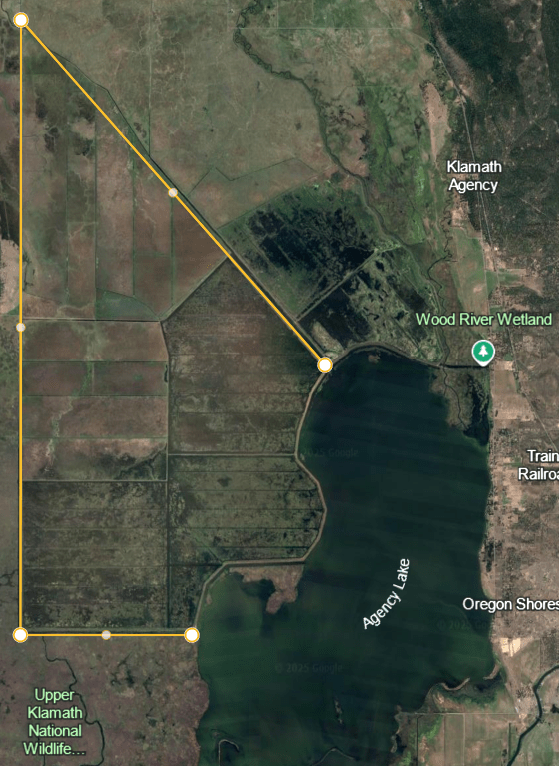
This post has been updated. See the end of the post.
Oregon Public Broadcasting recently reported that portions of a levee defining the west side of Agency Lake have been removed, creating significant new aquatic habitat. I used Google Earth to create the image on the left, the entire area inside the yellow lines will eventually be under water.
I have failed in my attempts to talk to someone directly involved with this project, so the rest of this post is based on the OPB article and my understanding of this area where I have spent a lot of time over the years. There are clear benefits for waterfowl and sucker fish. Any benefits for trout are less obvious.
Read More »Salmon are above the removed Klamath dams

You’ve probably already seen news reports on this, but yesterday ODFW reported the first salmon identified above the recently removed Klamath River dams. See the press release for more, including more photos and a video. Clearly, this is spectacular news.
While many have been trying to take credit for the dam removal, the truth is that various tribes, Pacific Gas & Electric, and the departments of fish and wildlife in California and Oregon have been the main drivers.
ODFW takes a lot of heat from the angling public, but they have been a key player in this project and I am thankful for their efforts.
A positive article on Klamath Dam removals
Negative news stories on the Klamath Dam removals continue to steadily appear. They have focused on issues that were anticipated, like murky water and a small amount of potentially toxic substances in the water. I remain unconcerned about these things. The river will clear and people should not drink directly from the river at any time. Here’s a recent article from NOAA Fisheries saying that dam removal and its impacts are progressing according to plan.
Premature Klamath concerns
Following negative stories like this one on from OPB, readers have contacted me with concerns about the Klamath Dam removal. I appreciate their emails, but so far everything is pretty much going as anticipated. Sediment levels in the river were predicted to be extreme but transitory. The impacts to fish in some areas will be dramatic for the next few months which is why mitigation efforts were undertaken prior to dam breaching, including capturing fish and putting them in safe areas. Believe it or not, the current turbidity levels are lower than some of the models predicted and dissolved oxygen levels have already improved. Further, dead panfish and catfish do not concern me at all, these are invasive species that thrived in the now-drained reservoirs but should not be in the Klamath River.
Read More »Klamath Dams removal update
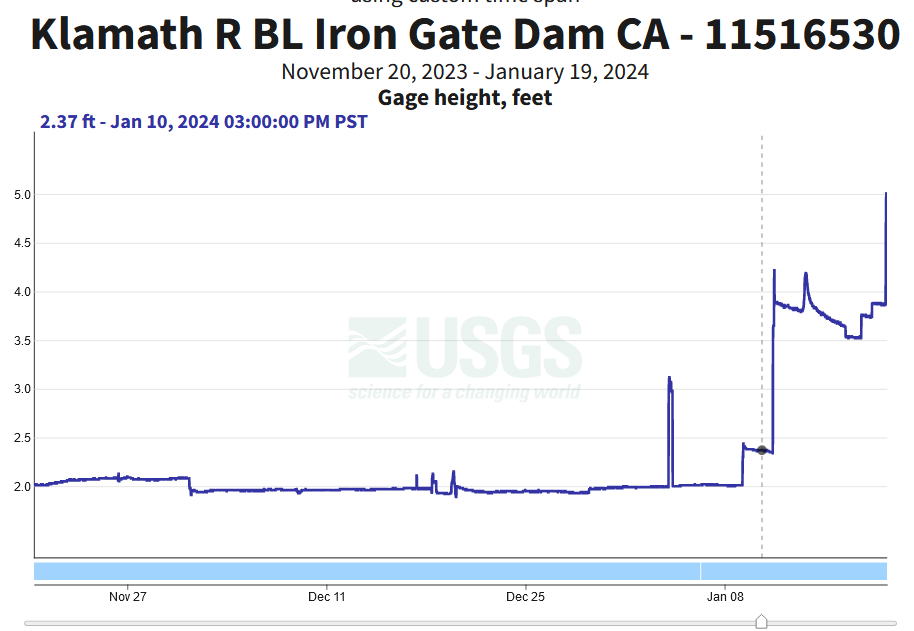
As you have probably heard, the reservoir drawdown behind some of the dams on the Klamath River has begun. See the chart above for the flows on the Klamath below Iron Gate Dam, the lowest of the dams that will be removed later this year. Here are some entertaining videos on YouTube showing the releases and an article with some background from OPB. Like many of you, I have been closely watching the dam removal for the obvious reason that removal is good for the environment but I also like to fish the Klamath River for steelhead. If you live in Central Oregon you might want to come to the next meeting of Central Oregon Flyfishers where I will present on fishing the river last year. Guests are always welcome.
Grab bag and some cool videos at the end
I’ve been preparing for my next fishing adventure, which starts tomorrow, and have not had the time to post, but as always there has been plenty to write about. So, here are a few short takes on Klamath Dam removal, the impact of ocean heating, our nationwide groundwater “crisis”, and some short videos of fish moving through Opal Springs dam.
Read More »The first dam is out

Oregon Public Broadcasting is doing an excellent job covering the removal of the dams on the Klamath River. Here’s their most recent story on the removal of Copco 2 with some cool photos and a video. I had a great time fishing below the dams last fall and really look forward to all the dams coming out.
Photo: Juliet Grable / JPR
Klamath Dam removal update
I spent the last three days at the annual meeting of the Oregon Chapter of the American Fisheries Society. It’s a scientific conference attended by fisheries biologists from the public and private sectors, but they let in me as well. One of the day long tracks on Thursday had to do with Klamath Dam removal, the largest dam removal project in history. Some of it was well over my head, like the talk titled “Responses of invertebrate hosts of salmon parasites to Klamath River flow events”, but there was a ton of useful information for anglers who treasure the Klamath Basin and look forward to what could be an improved fishing opportunity. Last month I was on the Klamath River in California below the dams and was impressed by the number of winter steelhead I hooked. If it can get even better it will be amazing. Keep reading for a very brief summary of the dam removal project.
Read More »Klamath River habitat restoration

As I predicted, now that some of the Klamath River dams are scheduled to be removed, everyone who ever made any comment about it is claiming partial credit. Dam removal was primarily a business decision by PacifiCorp. To the extent that outside influence played a role, credit should go to various Tribes whose ancestral homes were along the river and to Trout Unlimited. Based on some of the things they have done (or not done) in Oregon, I have a mixed view of TU but they deserve credit here. They are also seeing this effort through to the end by working with NOAA, PSMFC, and others to plan and implement the massive amount of habitat restoration that will need to occur in the “reservoir reach” of the river. This is unheralded work that must be done once the dams are removed. Here’s one page overview and here’s a great site if you want to dive into this wonky subject some more. (Take a look at page 3 of this document to see who is really working this issue.)
The Klamath River Dams really are coming out
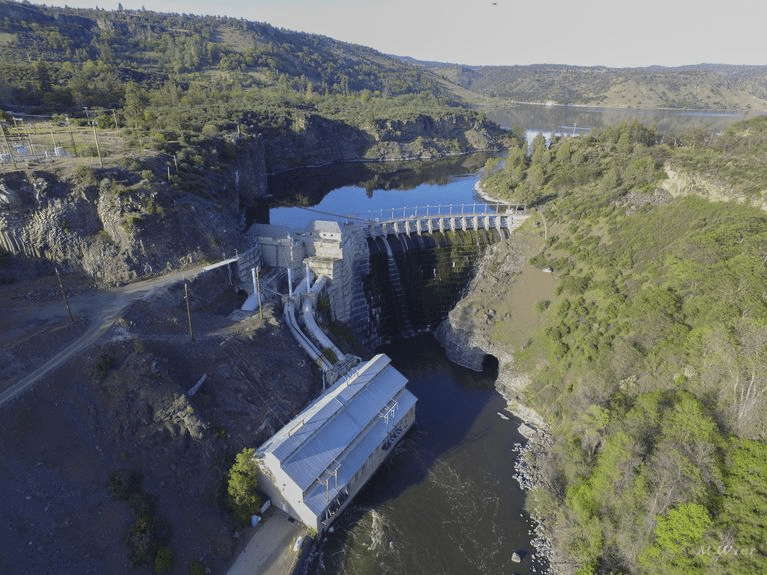
As you have probably already heard, yesterday the final hurdle for removing four dams on the Klamath River was overcome when the Federal Energy Regulatory Commission approved the plan submitted by the Klamath River Renewal Corporation. Here is a good overview of the project and some of the controversy around it. As is typical with major events like this, a lot of groups are going to attempt to take partial credit, but as this story makes clear, dam removal was primarily a business decision by PacifiCorp. It was simply going to cost too much to add the now required fish passage to the four dams*. FERC did not initially approve dam removal as PacifiCorp did not pledge sufficient funds to ensure removal and restoration. California, and to a lesser extent Oregon, subsequently stepped in with financial backstops which lead to FERC’s approval. A lot of work still needs to be done but this is fantastic news. (*Two other dams on the Klamath River are not being removed as they have functional fish passage. The effort to remove dams on the Snake River is different in that they have fish passage, albeit ineffective.)
HCN, OWRD, & Critical Groundwater Areas

As readers of this blog know, I spend a fair amount of time fishing all around the Klamath Basin and have been educating myself on its water and fisheries issues for many years. I think this area should be of interest to Central Oregon residents as the extreme water woes of our neighbors to the south are likely to be visited upon us as well. High Country News currently has a long, somewhat wandering article about water management in the Klamath Basin that might be worth scanning. The part that motivated me to write this post was the mention of “critical groundwater areas”. Coincidentally, I listened to a call by the Oregon Water Resources Department yesterday on the topic of critical groundwater areas, a concept we should all pay attention to.
Read More »Klamath Fishing Report

I have been avoiding fishing in the Klamath Basin this summer due to the drought and fires but decided I had waited as long as I could and spent 5 days over the past two weekends on some of my favorite bodies of water in that area. There were days with some smoke and it was hot at times, but the fishing was surprisingly good. The places I visited needed more water, but there was enough to support fish and the water quality was excellent.
The added bonus is that in those five days I saw a total of five other anglers. Five! Plus two kayakers. You need to know where to go, but that sort of experience is long gone in Central Oregon. Osprey, goose, and beavers were everywhere. Pelicans, herons, and many other birds as well. Sand hill cranes and coyotes called to each other in the morning.
Read More »The Klamath Basin is Dying
Readers of this blog know I have an affinity for fishing in the Klamath Basin. Today the longstanding drought is the most severe ever and the situation is dire. Rivers are at all time lows, the national wildlife refuge is now home to dust devils, migratory birds will soon have no place to rest and eat on their flight north, Upper Klamath Lake is so low that native fish cannot spawn, groundwater is dropping from unsustainable extraction, high temperatures are creating unprecedented kills of salmon in the Klamath River, forests are burning (around some great places to fish), and farmers are losing their livelihoods. There simply is not enough water to go around.
WaterWatch’s South Oregon Program Director Jim McCarthy recently had an excellent interview on OPB’s “Think Out Loud” where he outlined the problems and a solution that could work with a little legislative action. I think it is well worth 20 minutes of your time.
“In the Klamath Basin, pretty much everybody’s feeling the pain”
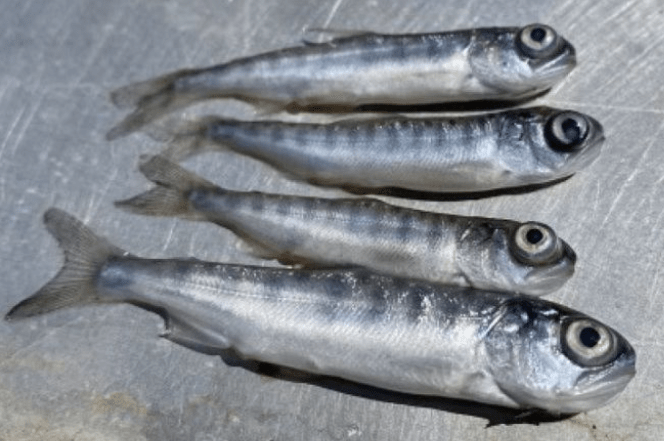
Yurok Tribe
That’s the title of an article on OPB.org. As readers know, I have a real fondness for fishing in the Klamath Basin (great fishing, few people), but the extreme multi-year drought they are experiencing is going to dramatically impact fishing, farming, and economies from the upper Basin out to the coast. The quote that really caught by eye was from Craig Tucker, natural resources policy consultant for the Karuk Tribe in California.
“This is 21st century global climate change hydrology,” Tucker said. “This is what the climatologists told us to expect is extreme dryness, followed by extreme wetness, and less snow. “We can’t use 20th century water plans to deal with 21st century climate,” he added.
This applies to the Deschutes Basin as well. Unfortunately, nothing is occurring in either basin at the scale or speed that is needed.
Klamath Dams Removal, Trout Genetics, and ODFW Management

A portion of the revenue from every fishing license goes into ODFW’s Restoration & Enhancement program, funds that are to be spent on projects that benefit anglers. Spending is controlled by an independent board where I have been a member for over 6 years. By statute, most dollars are spent on hatcheries and related projects, but we support other efforts as well, including some pure research. Research projects are a small proportion of the total as they typically do not show direct and immediate angler benefit, but we may fund them if we can see a longer term benefit.
Last week I saw the results of one such research project and believe there could be clear angler benefit. If you are at all interested in the impending removal of the four impassable dams on the Klamath River (the largest dam removal project in US history), love fishing in the Klamath Basin as I do, want to see the reintroduction of anadromous species in the Upper Klamath Basin, and are sometimes frustrated with ODFW, then you should read on.
Read More »Klamath Dams Removal Update

The Klamath River Renewal Corporation recently emailed their winter 2021 newsletter which had links to two items I enjoyed viewing. The first is a recording of a CalTrout webinar held last December which gave a detailed overview of the status of the project including planned efforts for landscape and tributary restoration. Dam removal is complex, requiring much more than simply tearing them down. The recording is over an hour long, with 39 minutes of presentation follow by Q&A. Removal of all four dams is currently scheduled for 2023. (CalTrout has an excellent web page on this topic was well.) The KRRC newsletter also contained a link to a powerful 14 minute film from American Rivers showing the 20 year effort by the Yurok Tribe to get to this point.
The Klamath Basin may seem off topic for this Central Oregon blog, but it is one of my favorite places to fish. Parts of the upper basin are less than 2 hours away from my home in Tumalo, the fishing can be excellent, and you can get away from people. Removing the dams should make a good thing even better.
The Klamath Dams are Coming Down!
Spectacular news. Today in a live Zoom call it was announced that the states of California and Oregon will replace PacifiCorp / Berkshire Hathaway as co-licensees of the Klamath Dams, which “ensures successful dam removal” and the “biggest salmon restoration project ever”. Dam removal will begin in 2022 and finish in 2023. FERC will have to approve the transfer, but Oregon governor Brown and California governor Newsom said that it will occur. FERC previously asked that PacifiCorp remain as co-licensee in order to provide a backstop in the case of cost overruns, that backstop will now be provided by California and Oregon. Learn more at klamathrenewal.org.
Klamath Dams: Progress or Setback?
Four dams are slated to be removed on the Klamath River, re-establishing hundreds of miles of habitat to anadromous fish. The long-negotiated plan was to transfer ownership of the dams from PacificCorp to the Klamath River Renewal Corporation (KRRC), a non-profit formed exclusively to oversee removal. Yesterday, the Federal Energy Regulatory Commission (FERC) approved transfer of ownership but with the stipulation that PacificCorp remain a co-licensee. I listened to the FERC meeting, read their ruling, and was enthused by FERC’s desire to have the dams removed. I also understand their caution to ensure sufficient funding is available to complete removal once started.
Read More »Decision on Klamath Dam Removal next Thursday
This is a little out in the weeds for most folks, but next Thursday at 7 AM Pacific is the Federal Energy Regulatory Commission meeting where the final decision will be made to transfer ownership of the dams on the Klamath River to the Klamath Renewal Corporation. This is the final hurdle before the dams can be removed. You can watch the meeting live here. I certainly plan to have it on in the background.
Conservation Hatchery on the Klamath River?
We’re practicing social distancing at our house, so last weekend I got the garage organized and caught up on some reading. A couple of weeks ago The Native Fish society sent out an email that neatly encapsulates both my respect and frustration with them. I agree completely that we should be doing everything possible to support wild fish in our rivers and streams. There is no scientific doubt that wild fish are superior to hatchery fish and that large scale planting of hatchery fish for harvest into waters that contain wild fish should be stopped. This is not a purely black and white issue, however, as was stated in research that NFS themselves referred to. Hatcheries can have a role to play outside of simply stocking ponds and lakes for put and take fishing.Read More »
More on Klamath Hatchery Plans
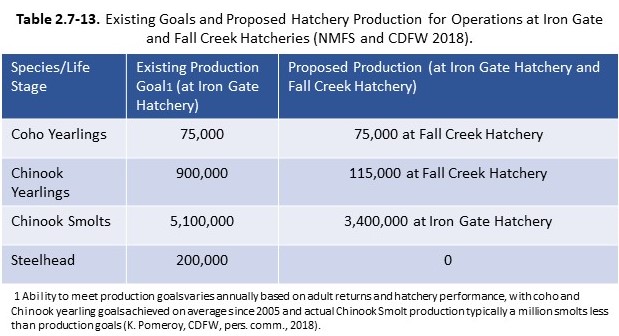
Last week I wrote about the controversy in the angling/conservation community about the use of hatchery fish in the Klamath River following the removal of the lower 4 dams, currently slated to begin in January 2021. I asked a few more questions and heard some good and some bad news from my perspective.Read More »
Klamath River Dam Removal Controversy
The excellent fishing in the Klamath Basin should get even better when 4 impassable dams on the Klamath River in California and Oregon are removed (J.C. Boyle, Copco 1 & 2, and Irongate). Dam removal will improve conditions for resident redband trout as well as allow for reintroduction of anadromous fish into their prime historical spawning habitat in the rivers and streams above Klamath Lake. On Thursday I was at a Klamath Lake Land Trust event where I was able to speak with Dave Meurer of the Klamath River Renewal Corporation, the organization that will soon own the dams and be charged with their removal.Read More »
Klamath Basin Fish Populations
As readers of this blog know, I have an affinity for the Klamath Basin. The trout fishing there is very good and it is relatively uncrowded. Over the past couple of years I have been a donor to the Klamath Lake Land Trust which is working on habitat acquisition and restoration in the upper Klamath Basin which could make a good thing even better.Read More »
Klamath Lake Land Trust
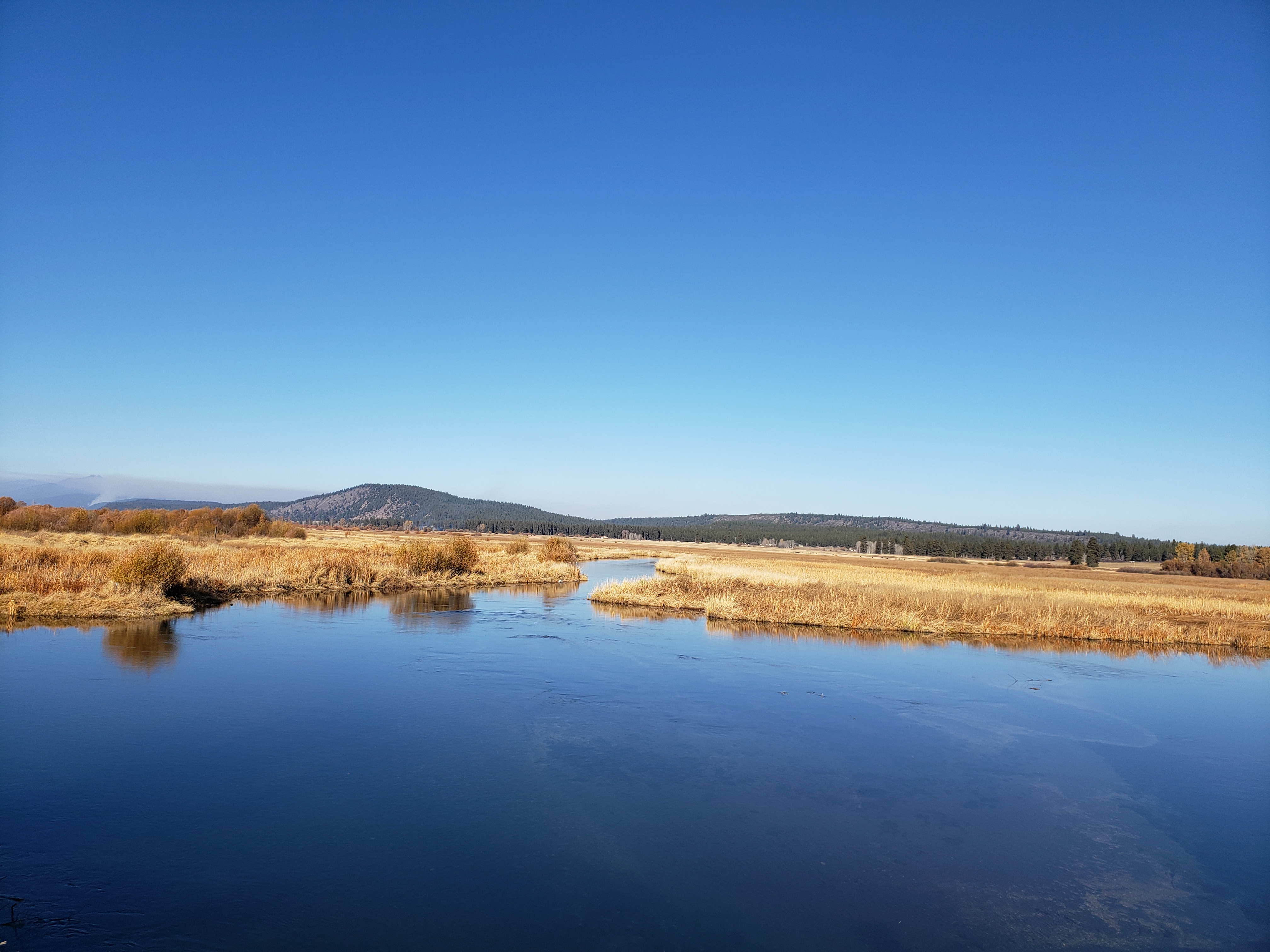
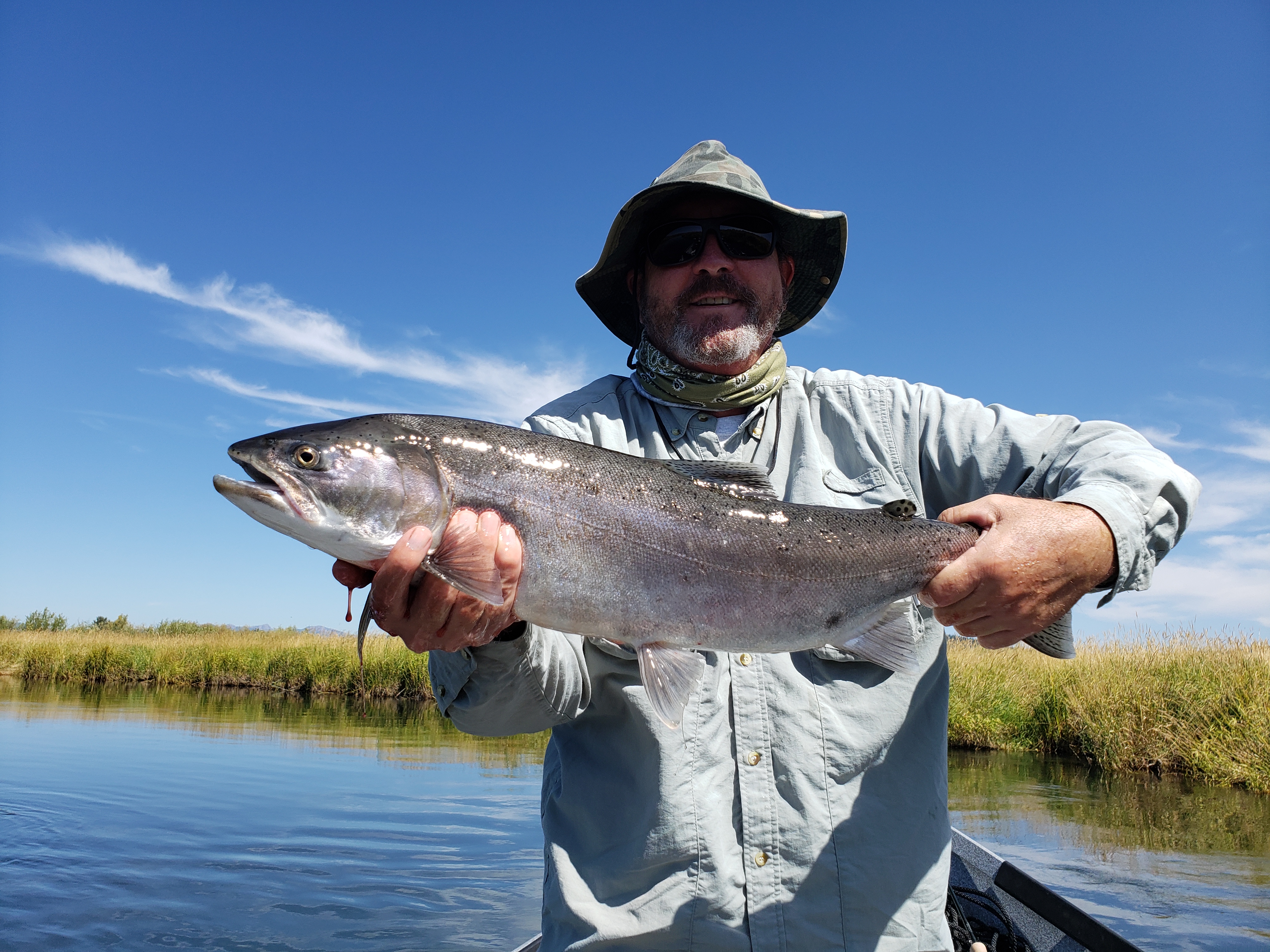
I like to spend as much time as possible in the Klamath Basin, it has incredible fishing and relatively low pressure. Above is a photo of the Wood River I took yesterday during a hike in the Wood River Wetlands, it was beautiful as always. Below is a photo of my friend Matt with a 26 inch trout he caught when we were fishing there last August.
I spent yesterday evening at the Klamath Lake Land Trust’s annual dinner and fund raiser. The KLLT is a small, woefully underfunded group working to preserve places on the Sycan and Sprague rivers where steelhead and salmon may spawn once the impassable dams on the Klamath are removed in 2022. I was glad to see a number of Klamath residents open their wallets for this worthy goal.
The spectacular fishing in this part of the state may soon be even better.
Latest R&E meeting: Klamath and Williamson rivers
I’m back from the latest ODFW Restoration & Enhancement board meeting, this time held in Klamath Falls. We had two great days of touring past, current, and future fisheries projects. I have always been surprised by how few Central Oregon anglers venture to the Klamath Basin. It is only 2-3 hours away, depending on where you go, and the fishing is both spectacular and uncrowded.Read More »
 Central Oregon Informed Angler