
The notes from the monthly Crooked River call were released today. It should surprise no one that the outlook for Prineville Reservoir is not good. It is only 69% full and “unlikely” to fill as there is extremely low snowpack in the Ochoco Mountains. Flows into the Crooked River will be kept at around 80 cfs until irrigation season starts next month. My prediction is that the real impact will be felt at the end of irrigation season next fall (traditionally in mid October) when there will be little water left in the reservoir. I hope we don’t have a repeat of 2022 when flows were drastically reduced between the end of irrigation season and the beginning of HCP mandated flows which resulted in significant fish population declines.
Category: Crooked River
Crooked flows reduced
Last Thursday the BoR made the decision to reduce Crooked River flows out of Bowman Dam from 100 cfs to 80 cfs. (It has actually been around 77 cfs since February 5th.) I was just able to read the minutes from the meeting where this decision was made and it is due to “unprecedented drought risk”. This is a major change from prior meeting minutes which were optimistic about precipitation in the second half of the winter. Both Prineville and Ochoco reservoirs are below normal for this time of year and now are not expected to fill as snowpack and inflows are at record lows.
It’s too early to worry, but…
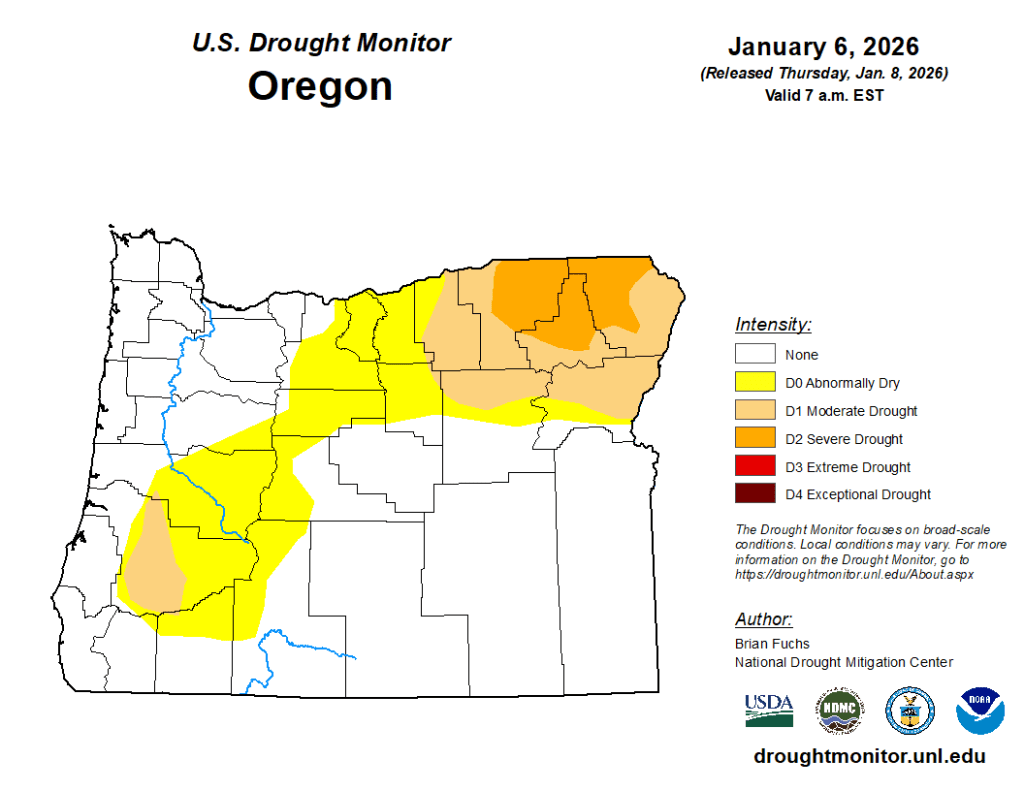
Like me, I’m sure that many of you are starting to be a little concerned about our winter so far. From a fishing perspective, it’s a mixed message. As you can see above, drought is not currently a major issue in Deschutes County or most of the state. This is due to the rain we have been getting. It’s a very different story when it comes to snowpack, however.
Read More »ODFW Central Oregon update
Two days ago Tim Porter from ODFW gave his annual presentation to Central Oregon Flyfishers on all things Central Oregon. You can see his slides below but I’ll provide a quick overview. Tui Chub trapping on East Lake continues but there is no identified funding for future efforts. New funding is being sought and tiger trout will be planted in East and Paulina next fall. Tigers have been very effective in controlling chub in Diamond Lake. Hopefully we will not see an explosion of chubs in East and Paulina.
Read More »LBC Pumping Station
Some of you may remember that about four years ago North Unit Irrigation District floated an idea to move their aging pumping station from the Crooked River to Lake Billy Chinook. I registered my concern with this plan as originally outlined. Thankfully, NUID was open to listening to my concerns. As I mentioned to them in a subsequent conversation, I believe the angling community could either enthusiastically support this plan or be in wild opposition. Yesterday an update on the plan was presented to the Deschutes Basin Water Collaborative and they said all the right things from my perspective.
Read More »Good news for the Crooked River this winter
The notes from the latest Prineville Reservoir status meeting were recently released. This is a monthly meeting between the Bureau of Reclamation, other agencies, irrigation districts, and the City of Prineville. The BoR has determined that they will be able to maintain at least 80 cfs between whenever irrigation flows out of Bowman Dam are turned off through October 14th. After that, minimum flows will be 100 cfs until the beginning of irrigation season on April 14, 2026. They cautioned that Prineville Reservoir is still over 60% full so flows could be much higher at times in the winter for flood control purposes depending on rain and snowpack.
Crooked River fish sampling
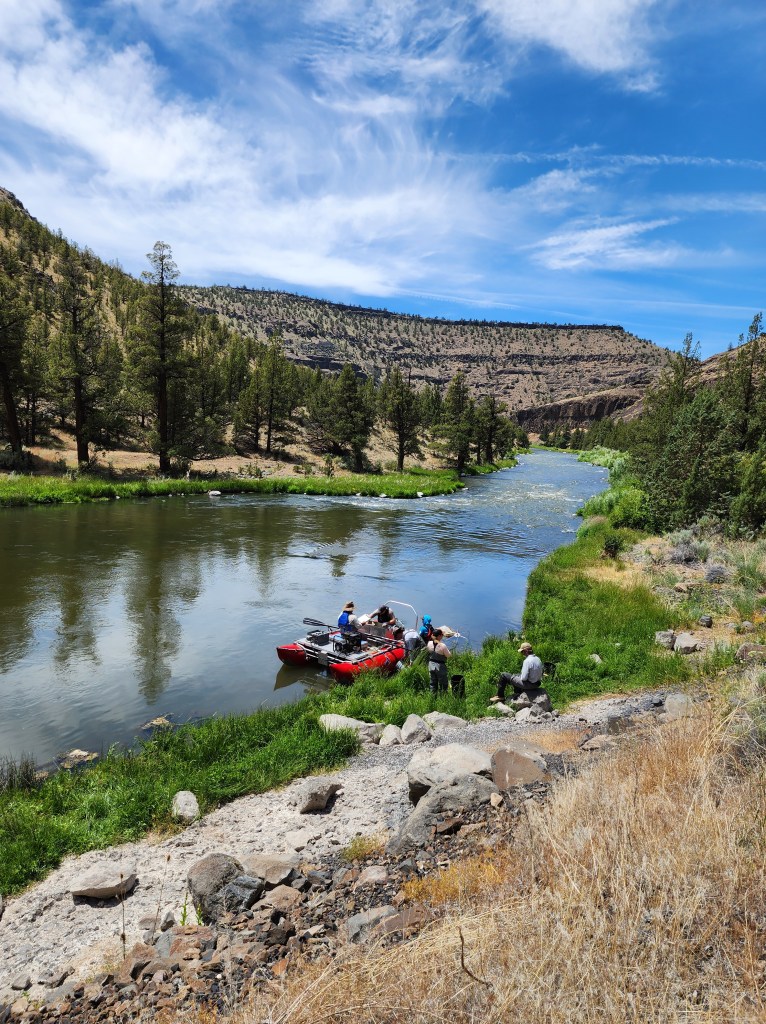
This week ODFW is performing their annual fish sampling on the upper half of the wild and scenic section of the Crooked River below Bowman Dam (Big Bend to Cobble Rock). As usual, I helped out one day carrying buckets of fish and releasing them in various places after they had been measured and weighed. I’ll post the final report from ODFW once it has been completed sometime in August, but the biologist’s initial assessment is the fish population looks very similar to last year. Lots of whitefish and trout, some with reasonable size including a handful of redbands over 16″ yesterday, the day I volunteered. The other volunteer that day is a frequent angler on the Crooked and, like the first time I volunteered many years ago, was surprised by how many fish were in locations that he had never fished. Keeping reading for a video.
Read More »Spring chinook are heading up the Crooked
Don’t try to catch them! Thankfully, there’s enough water in the river to let them get upstream of Opal Springs Dam.
Ochoco Preserve Photos

You are probably aware of the Deschutes Land Trusts’ Ochoco Preserve. It is a restoration project where Ochoco and McKay creeks meet the Crooked River. Flows in this section of the Crooked River are higher than below Bowman Dam during non-irrigation season due to tributary inflows. Here are some photos from DLT restoration specialist Jason Grant that he took yesterday when flows at the site were over 3,400 cfs. If you have visited the preserve you know that this is not how it normally looks. The good news is that the river can spread out at the preserve and do what rivers are supposed to do at high flows. Hopefully spawning steelhead have found their way to this project and even gone up McKay Creek.
Read More »Bad news for fish in the Crooked River
As you can see in the chart above from yesterday, flows in and out of Prineville Reservoir are very high and gas bubble disease is sure to occur. If you look at the details this morning, it is even worse.
Read More »Steelhead moving up the Crooked
As of two days ago, February 21, roughly 188 steelhead have moved up the Opal Springs fish ladder near the bottom of the Crooked River. 54 of these have also gone back down. I say “roughly” as a few fish have been known to go up the ladder, relatively quickly go back down, and then head back up. So, there could be a little double counting. Others go up, spawn, and then head down. Remember, it is illegal to fish for steelhead above Round Butte Dam.
Read More »Lower Crooked River flows protected
UPDATE: A reader alerted me to the fact that I made a glaring error in this post. I used the abbreviation BLM (Bureau of Land Management) when I meant to use BoR (Bureau of Reclamation). Mea culpa. Sometimes I need an editor.
Yesterday I received a personal email from Advocates for the West stating that “on February 10, the Crook County Circuit Court rejected several ranchers’ attempt to invalidate a water right issued by the Oregon Water Resources Department (“OWRD”) to protect flows for fish and wildlife in the lower Crooked River.” This was in response to legal action by Advocates on behalf of WaterWatch. I’ll provide some background, but the bottom line is that flows that should have been protected for over a decade below the Wild & Scenic section will now be protected all the way to Lake Billy Chinook. I assume that Advocates and Waterwatch will publicize this soon, but here’s an early preview.
Read More »Crooked River flows and forecast, UPDATED
UPDATE: This morning I thought woke up thinking about the written comment from BoR, “Moving into La Nina trends, which could mean a warmer and wetter winter for Central Oregon”, which I repeated in the post below. So, I looked to NOAA which stated that a La Nina typically makes Oregon cooler and wetter. Go figure. Regardless, the Crooked River should be high for some time.

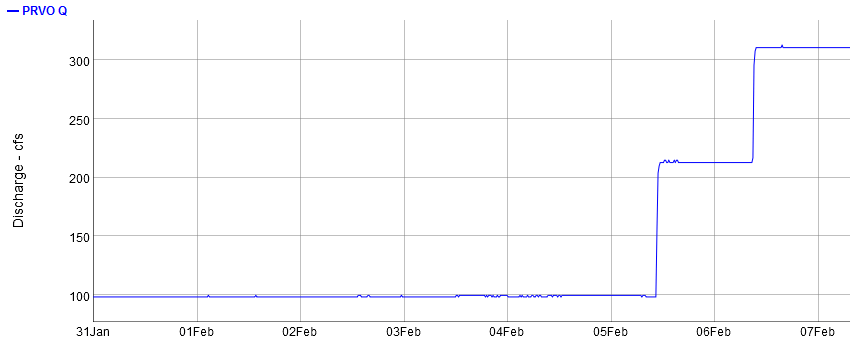
ORIGINAL POST: You may have already seen this chart showing the recent increase in flows out of Prineville Reservoir into the Crooked River. I took a look after receiving the notes this morning from the monthly water operations call that occurred two days ago (Feb. 5). You should expect high flows for some time. The Ochocos are experiencing an above average snow year. As a result, while Prineville Reservoir is 57% full as of this morning, it does not have remaining storage capacity to accept what is anticipated to be a large amount of runoff (perhaps 300% of normal) when temperatures increase in the spring or from a rain on snow event. The notes also point out that a developing La Nina could bring warmer temperatures and precipitation as rain. As a result, outflows into the Crooked River could be high for “extended” periods, likely for months. This is bad news for fishing this winter but good news for summer fishing and good news for the record number of steelhead that are currently attempting to make their way up the Crooked River.
High flows on the Crooked

For years, Central Oregon Flyfishers had an outing to the Crooked River on January 1st to start the New Year. That tradition has gone by the wayside, but I thought about heading out there and looked at the flows. They have ramped up dramatically out of Prineville Reservoir. Not good for fishing, but good for the record numbers of returning steelhead. The reservoir is already 60% full and there’s good early season snowpack in the Ochoco’s, so the reservoir already has to be lowered just in case there’s a big rain-on-snow or other melt event. The Bureau of Reclamation is concerned about early, high runoffs this spring as recent fires have reduced tree cover over the snow which could lead to quicker than normal snow melt. Global warming marches on. BTW, Wickiup is 55% full but releases are steady at just over 100cfs.
Recovering Deschutes Basin Steelhead — Part 2
Central Oregon LandWatch has released part 2 of their series on steelhead in the Upper Deschutes Basin. This one covers some local steelhead history and the causes of their rapid decline. It is well done, with some nice videos and graphics. I was impressed. It’s worth your time to take a look.
Spring chinook in the Upper Basin
My plan was to post about final spring chinook numbers passed into Lake Billy Chinook right about now, but they are still being captured. As a preview, here’s a video of one passing through the Opal Springs fish ladder last month.
Crooked River sampling results
Below are the recently completed graphs from ODFW showing the results of their Crooked River electrofishing sampling of trout and whitefish last June. See this post from last year for some more context. ODFW will present these results, as well as discuss ongoing tui chub removal efforts in local lakes and their macroinvertebrate study of the Upper Deschutes at the Central Oregon Flyfisher’s meeting on September 18. All are welcome.
Read More »Two quick items
I’ve been busy fishing around Oregon, working on my boats, preparing for my next extended trip in a couple of days, and have fallen behind on posts, so here are a couple of things: Deschutes steelhead and USFW’s Crooked River flow request for irrigation season.
Read More »The Crooked River through rose colored glasses
The Deschutes River Conservancy recently had their second “Raise the Deschutes” seminar of 2024, this one titled “A River Runs Through It: Collaborative Strategies for the Future of the Crooked River”. It provided a brief history of agriculture and dam construction in Crook County, a hydrology overview, and the basics of how water is managed in the Lower Crooked River. As you would expect, I have criticisms which begin with the opening remarks claiming that the dams on the Crooked River and Ochoco Creek provide benefits to fish. Dams benefit fish in the Crooked Basin? Only if you want to promote invasive species. Clearly, dams benefit people while harming wild, native fish. While actions may be taken to provide some water for fish, at the end of the day they lose. The presentation made no mention of the lethally low or high flows that occur in the Crooked River. The massive use of water by the data centers in Prineville was falsely characterized as being benign. There was no discussion of planning for a drier, warmer future. I understand that fish and wildlife will always lose the battle for water, but we should acknowledge this, not gloss over it.
Read More »Crooked River going to 2,000 cfs
The Bureau of Reclamation is pushing the release out of Bowman Dam to 2,000 cfs today. This is required for flood control, which is the primary purpose of the dam. Prineville Reservoir is now at 84% of capacity and they need to keep space for more inflows. This is problematic for fish as it will introduce potentially lethal gas bubble disease, particularly for fish over 12″. Gas bubble disease is caused by the turbulence from high flows released from the dam which supersaturates the water with atmospheric gases. The Crooked would have high flows prior to the dam being built, but the water could spread out in the canyon, not be forced through a small opening. The fish ladder at Opal Springs Dam has also been shut down due to high flows which is unfortunate as there are steelhead who now want to move from Lake Billy Chinook up into the river.
Crooked River at 1,550 cfs

Time to start planning for bull trout on Lake Billy Chinook
As readers of this blog know, the pursuit of bull trout on Lake Billy Chinook using fly fishing gear dramatically changed with the reintroduction of steelhead and spring chinook salmon in the Upper Deschutes Basin. Prior to this, fly anglers would target bull trout chasing kokanee smolts in late winter and early spring as they moved out of the Metolius River. (The Metolius arm of LBC opens March 1, be sure to get your tribal permit, which are not yet available for 2024 as I write this.) Since reintroduction efforts began, however, salmon and steelhead have been planted in the Crooked, Metolius, and Middle Deschutes Rivers and their tributaries, making those arms of LBC attractive places to fish as well.
Read More »It’s happened…
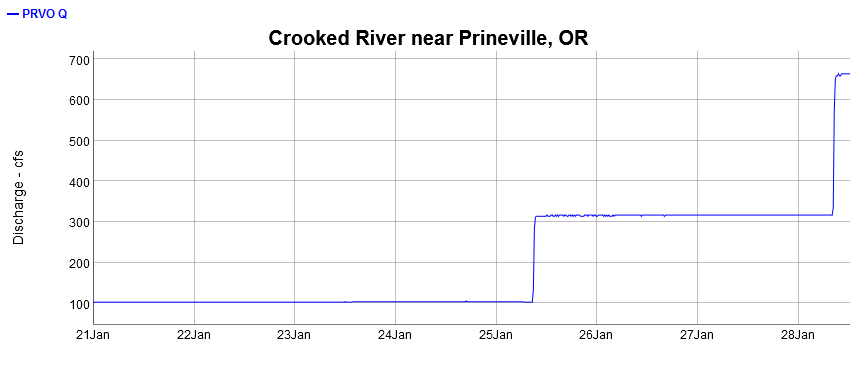
The Crooked below Bowman Dam is now at 664 cfs. The river coming into Prinveville Reservoir is at 4,200 cfs! The reservoir is over 70% full and capacity has to be reserved for more inflow this winter.
Read More »Watch those Crooked River flows
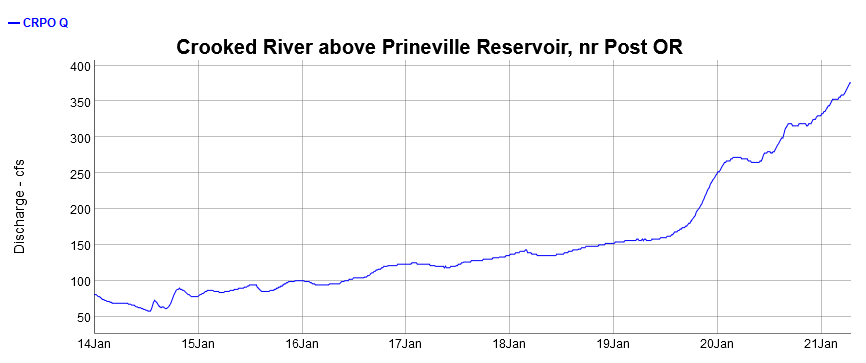
As I have recently been writing about, the Bureau of Reclamation has been warning of potentially needing to increase releases into the Crooked River from Prineville Reservoir in order to keep enough room in the reservoir to accommodate large inflows. Well, flows from snowmelt are happening now with the current rain on snow event. Above is the chart for the Crooked River coming into the reservoir. The releases from the dam have not been increased yet, but don’t be surprised if it happens.
Prineville Reservoir release update
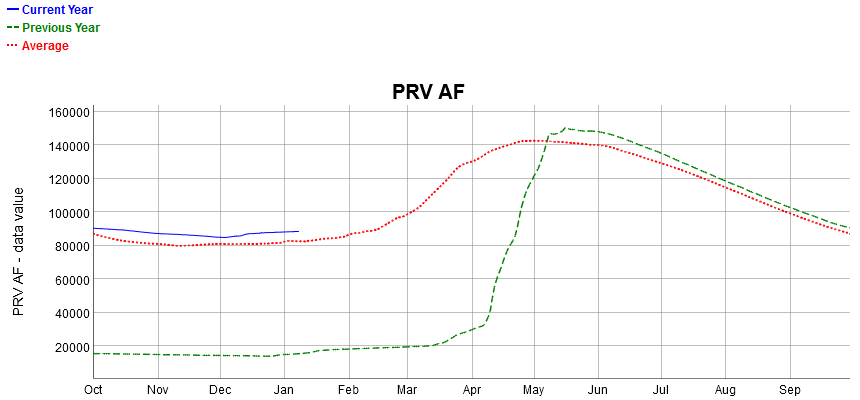
The monthly Prineville Reservoir/Crooked River update meeting occurred on January 3rd and I received the notes yesterday. See this post from last month for background. The reservoir level continues to be above average for this time of year* and is approaching the flood rule curve, which would require additional releases into the Crooked River, but as of January 3rd there had been little recent precipitation. There was discussion about the potential to release water in a gradual manner to be less detrimental to fish along with discussion about the uncertainty of future weather and potential dry scenarios.
* The reservoir level is above average as most of the precipitation in the drainage this water year has been rain rather than snow, or snow that soon melted.
Stock runs and river kills
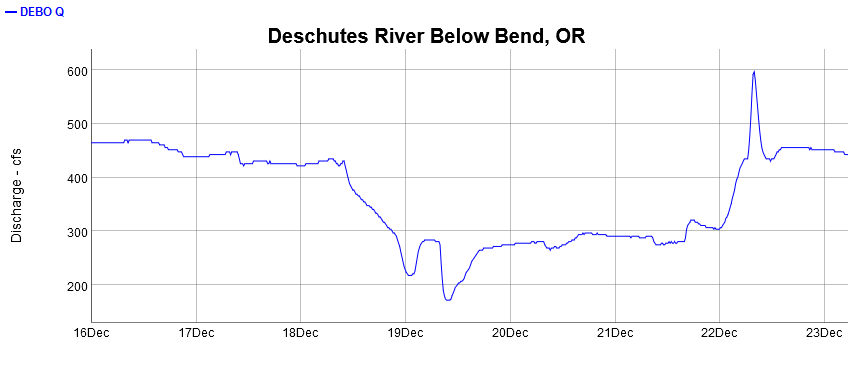
Central Oregon Irrigation District has now finished their latest “stock run” and you can see its impact on the Middle Deschutes below Bend. Over the course of 5 days the river level has fluctuated wildly with a low of 172 cfs and a high of 592 cfs. Such dramatic swings in a short period of time expose the river bed and its plants and aquatic insects to potentially lethally low temperatures. High flows then generate sediment which chokes spawning beds. Of course, this has been going on for years. With all the focus on restoring the Upper Deschutes (the river above Bend), the Middle Deschutes continues to be an irrigation ditch.
Read More »Prineville Reservoir increased discharge soon?
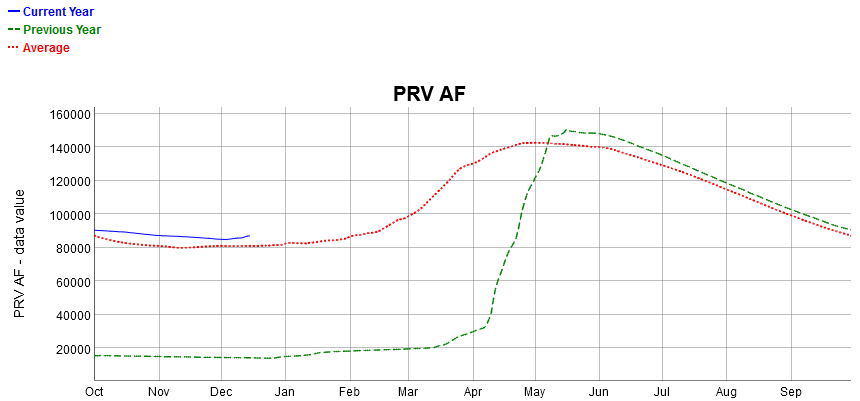
The Bureau of Reclamation hosts a monthly discussion for various stakeholders and agencies on the operation of Bowman Dam. The most recent meeting was on December 6 and I finally had the opportunity to read the notes. The bottom line is that anglers should be on the lookout for increased flows into the Crooked River, perhaps before the end of the month. Keep reading to understand why. The graph above is from the BoR and shows water measured in acre feet in Prineville Reservoir as of today.
Read More »An environmentalist and a taxpayer
Last month the Oregon Water Resources Commission approved grants collectively worth $12,232,393 to Ochoco, Arnold, North Unit, and Tumalo irrigation districts for canal piping and related projects. With a total cost of $83,355,578, these efforts will place just under 30 cfs (cubic feet per second) of water back instream. The environmentalist in me understands the benefits of these projects. Our local rivers and streams are in terrible shape, impacting fish, wildlife, recreationists, and our local economy. The taxpayer in me is not enthusiastic about paying an average of $2,785,483 per cfs.
Read More »Whiskey is for drinking, water is for fighting
A few days ago the Bulletin carried a story from the Capital Press titled “Irrigators sue over Prineville Reservoir water releases“. As I mentioned in this post last month, when the Crooked River Act was passed in December 2014 it stated that water in excess of irrigation needs be released for the maximum biological benefit of fish all the way to Lake Billy Chinook. Unfortunately, that water was not protected with an instream water right which allowed water right holders downstream from the City of Prineville to withdraw it. It took 9 years (!) but that water was finally protected last month. Crooked River irrigators upstream from Prineville Reservoir are now suing to overturn that water right. This is absurd, the right does not affect them, and is another great example of how entitled and combative some water rights holders are.
Read More »Some recent Opal Springs fish videos
I have not shared any of these for a while, so here are a few very short videos of big fish swimming up the fish ladder at Opal Springs on the Crooked River.
Crooked River flows and instream water right
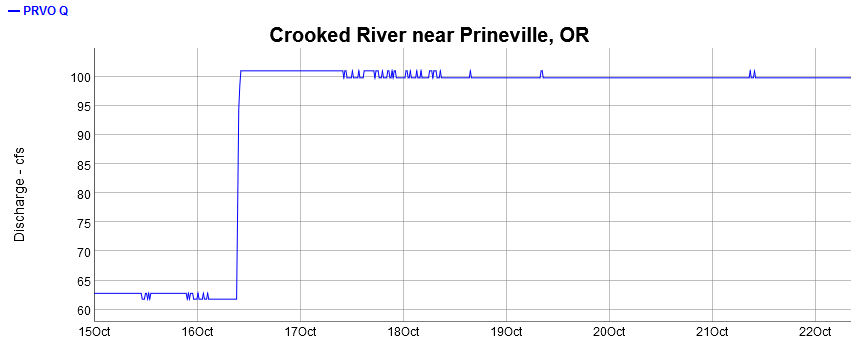
I’m a few days late on this, but I just had the chance to read the notes from the October 4 monthly meeting where Prineville Reservoir and Crooked River management is discussed. The notes (released October 16) stated that a healthy water balance in Prineville Reservoir will allow for releases of 100 cfs, hopefully through the winter, and should start on October 16. Checking the gauges I see this has occurred. Let’s hope for a wet winter and sustained winter flows in the Crooked!
Read More »Grab bag and some cool videos at the end
I’ve been preparing for my next fishing adventure, which starts tomorrow, and have not had the time to post, but as always there has been plenty to write about. So, here are a few short takes on Klamath Dam removal, the impact of ocean heating, our nationwide groundwater “crisis”, and some short videos of fish moving through Opal Springs dam.
Read More »Maybe a little bit of good news for the Crooked River?
We all know that Prineville Reservoir filled this past winter and the Wild & Scenic section of the Crooked River below Bowman Dam has had good flows this spring and summer. Of course, this section of the river is rarely a problem during irrigation season. The river mostly suffers from low flows, sometimes lethally low, during storage season. Last week, the US Fish & Wildlife Service and National Marine Fisheries Service released their “final recommendation” for how to release the water stored in the reservoir for the remainder this year and through next winter. I’ll provide some discussion, but the bottom line is that if this plan is approved and implemented by the Bureau of Reclamation, reasonable amounts of water should be released into the Wild & Scenic section all winter. As usual, the problem on the Crooked River will be below that section.
Read More »Annual Crooked River fish survey results
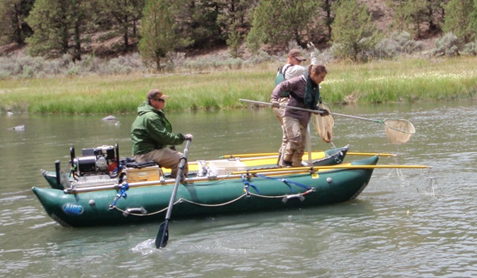
Almost every year the Oregon Department of Fish & Wildlife electrofishes the Crooked River to estimate redband trout and whitefish abundance. Following the very low flows on the Crooked River last fall, the results of the survey this spring were eagerly anticipated. The numbers were better than feared but showed a decline. Trout decreased by 20% from the prior year, mostly fish larger than 12″. Of course, larger fish are what anglers want to see. Additionally, the surviving larger fish had lower weights compared to the prior year indicating limited food availability. Fish can move to find survivable habitat much more successfully than macroinvertebrates, so it makes sense. Whitefish declined by about 50%. Plenty of anglers enjoy catching whitefish. Overall, the survey was bad news, but it could have been worse.
Read More »2022 steelhead smolt survival in the Crooked River

There were many very interesting presentations at the annual Deschutes Fisheries Workshop last week which I will be diving into soon. One of them was on downstream smolt migration and survival in the Crooked River in 2022. Last Wednesday Tim Porter, ODFW Deschutes District Assistant Fish Biologist, gave one of those presentations to Central Oregon Flyfishers where I was able to get many questions answered. In short, the presentation was alarming. Keep reading for the presentation and a discussion.
Read More »Crooked River fish count: day 1

Today I helped with the first of four days of fish sampling on the Crooked River below Bowman Dam. The good news is that we captured some healthy redbands. As predicted, the numbers are definitely down from the past few years, maybe only a third as many, but there are fish in there. Extremely low flows and high temperature last fall, cold temperatures in the winter, and flows above the level that introduce gas bubble disease this spring made this an easy forecast. This 20.5″ fish was by far the largest, but had no adipose fin, so was almost certainly one that came down from Prineville Reservoir where hatchery fish are stocked. That is most likely going to be the case for most of the larger redbands in the river this year. Of course, it was only day one, so I look forward to the final results. The photo is of Tim Porter, ODFW Assistant Deschutes District Fish Biologist, who will present the findings of the survey and talk about other local fishery issues at the July 19th Central Oregon Flyfishers meeting.
Water quality, science, and agendas
If you read this blog then you are most likely already aware that the Oregon Department of Environment Quality is currently proposing to update rules for temperature and dissolved oxygen standards in water bodies throughout the state. You can learn as much as you would like about this on their website. Earlier this week ODEQ held a Zoom meeting to go over the proposed changes, answer questions, and take public testimony. After reading most of the materials on the ODEQ website, watching the presentation, and listening to the public testimony, I was reminded of the keynote speech at the last Oregon Chapter of the American Fisheries Society meeting which encouraged professional fish biologists to not despair and continue to work on good science, even when so many detractors, even those claiming to represent fish, try to undermine their work.
Read More »ODFW Crooked River sampling: learn where the fish really hold
Every year ODFW electrofishes the Crooked River below Bowman Dam to estimate fish size, health, and abundance and they are looking for volunteer help June 21-23. Volunteers walk down the bank of the river while ODFW biologists float and shock the river. Fish near the boat are temporally stunned by the electric current and float to the surface where they are captured, counted, and measured. I first helped with this many years ago and it made me a far better angler on the Crooked and elsewhere. Even after decades of fishing experience and “reading the water”, I was amazed to see where fish were holding and in what numbers. If you are interested in helping, contact Tim Porter, Assistant District Fish Biologist in Prineville, at (541) 447-5111 ext. 24 or Timothy.K.Porter@state.or.us. Let him know which day(s) you can help and he will get back to you with more detailed info. You need to be able to carry buckets of stunned fish back upstream to release them near where they were captured. The day usually lasts from 8:30 am until 2 pm.
Bad news for fish in the Crooked and Middle Deschutes Rivers: CORRECTED
It’s irrigation season and, as usual, the Middle Deschutes is getting killed. Below are graphs showing flows in the Deschutes just below the Central Oregon Irrigation District and North Unit Irrigation District diversions at the North Canal Dam just upstream from the Mt. Washington bridge in Bend. As you can see, over the past two weeks fluctuations in the river have been abrupt and dramatic. This strands fish and other aquatic life and stirs up sediment that chokes spawning beds. (CORRECTION: in the section below on gas bubble disease, I missed a zero. Gas bubble disease is a real problem around 3,000 cfs, not 300 cfs as originally stated and now corrected. Sorry about that. Flows this morning out of Bowman Dam are are 2,020 cfs with inflows at 4,500 cfs.)
Read More »“Pulse Flow” on the Crooked starting April 17
Here’s a message from ODFW: “The USFWS and NOAA have decided to release some water from Bowman Dam next week as a smolt pulse to help steelhead smolts move downstream. We’re trying to let as many constituents know as possible to help minimize inconveniences. The pulse flow will start on April 17 where they will slowly increase the amount of water released throughout the day to ramp up at an appropriate rate. The full 250 cfs pulse will be released all day on the 18th and 19th, and then will slowly be ramped back down to base flow on the 20th. We are uncertain at the moment what base flow will look like at that time since OID has indicated they may start releasing irrigation water on the 17th. Irrigation flows usually average about 200 cfs so the total amount of water could be anywhere from 250 cfs to 450 cfs.”
I would avoid fishing the river during the pulse flows. Given the low amount of water in Prineville Reservoir combined with continued uncertainty about timing and amount of snow melt and runoff into the reservoir, this is a pretty significant event.
The start of irrigation season and water outlook

Central Oregon Irrigation District has announced that their main canals will “turn on” starting April 10. North Unit Irrigation District is scheduled to start April 15. Nonetheless, I drove over a main canal today and it has water in it. So, here are some thoughts about the outlook for this irrigation season and its impact on local fisheries. We have been very lucky with late season snowfall, but it’s not as good as it is often portrayed to be. Our reservoirs, lakes, and rivers will need a lot more than one decent winter snowpack to return to healthy conditions.
Read More »Bipartisan Drought Relief and Water Security Package
I am a frequent critic of local and statewide politician’s lack of attention to water use and scarcity but a small step in the right direction is currently being considered in the legislature. HB3124, titled the “Bipartisan Drought Relief and Water Security Package”, has elements that would begin to address important issues. It would direct the Oregon Water Resources Department to “study” drought (really, the legislature needs to direct OWRD to do this?) and include strategies for drinking water, agriculture, fish, and water projects. Locally, it would allocate $2 million to the Deschutes River Conservancy. The next public hearing and work session is on April 3rd. Keep reading for background information, some resources, and my criticisms (of course).
Read More »Spring chinook and Crooked River flows

The Deschutes Valley Water District maintains a spreadsheet that identifies and counts the fish that pass through the ladder at Opal Springs Dam on their way up the Crooked River. It’s pretty interesting to see how many and how many different types of fish use the ladder. I had never even heard of a chiselmouth before seeing thousands of them in the spreadsheet heading up river to spawn in the spring. Anyway, I have been thinking about drought and local river levels and went back to correlate flows with spring chinook returns last summer. It was as bad as I expected.
Read More »CO Daily News and Prineville water policy

A few days ago Central Oregon Daily News ran a story on the “award winning” way the City of Prineville stores water by pumping it into an aquifer for later use. Aquifer recharge is a tool that is getting a lot more interest as our planet heats. Storing “excess” water in the ground for use later is conceptually a good idea. It is a lot less expensive and controversial than building new reservoirs. As usual, when it comes to water, however, the devil is in the details. I wrote about Prineville’s plan over a year ago and pointed out the serious ecological problems it creates for the Crooked River and the fish and wildlife that depend on it. Read the post for a longer discussion, but in summary, there is no excess water in the Crooked River. The aquifer being drawn down is naturally recharged in the winter when flows may be higher and the water is naturally released in the summer providing cool water when the river needs it. Pumping down that naturally recharged aquifer and moving the water to another “contained” aquifer for storage, water that is not released back into the river but is used by data centers, helps the Prineville economy and municipal water system but further degrades the Crooked River which has been on life support for many years.
Thoughts on a HCP lawsuit
I have closely tracked the Deschutes Basin Habitat Conservation Plan from the very beginning. Well over a decade ago I submitted comments in support of listing the Oregon Spotted Frog as an endangered species. While the OSP is important, more important to me was the understanding that an ESA listing would force the irrigation districts to release more water into the Upper Deschutes River during the winter, parts of which had been essentially drained dry almost every winter for decades. For years, I attended seemingly endless meetings studying the Upper Deschutes with government agencies, NGOs, and irrigation districts which helped inform the creation of the Deschutes Basin Habitat Conservation Plan. Through all this I was often deeply disappointed and was certain that the HCP would be challenged in court. Now that a lawsuit appears imminent, I have mixed feelings. How can more water flow in the river without harming real agriculture in Central Oregon, especially given our increasingly hot climate? How can a lawsuit affect a meaningful outcome and not create a lengthy cycle of litigation?
Read More »Deschutes Basin HCP notice of intent to sue
Yesterday the Center for Biological Diversity notified the Department of the Interior, the Bureau of Reclamation, and the U.S. Fish and Wildlife Service of their intent to sue for Endangered Species Act violations in the Deschutes Basin Habitat Conservation Plan. You can read the entire 53-page notice here. In summary, CBD contends that the HCP will not provide adequate protection for the Oregon Spotted Frog, an ESA-listed species. While there has been much talk about potential litigation over the years, I was surprised by this development. Conversations I have had with conservationists in Oregon for some time could be summarized as frustration with the HCP but a belief that the drought precluded any ability to materially increase flows without significantly harming irrigators which they were reluctant to do. My greatest personal frustration with the HCP is centered mostly on the lack of meaningful protection of flows in the Crooked River, home for steelhead and salmon, but this is not mentioned in the notice.
ODFW report on the Crooked River: not good

The Wild & Scenic section of the Crooked River below Bowman Dam is prized by anglers from all over Oregon who target abundant wild, native mountain whitefish and redband trout. The Oregon Department of Fish & Wildlife annually surveys fish populations in the river in June. Unsurprisingly, over the years ODFW has recorded a direct connection between river levels and fish health. Specifically, flows below 35 cfs have been shown to have strong negative impact on trout abundance.
The period from mid-September to November 1, 2022 witnessed an unprecedented reduction in flows in the Crooked to approximately 10 cfs. In response, ODFW conducted a survey in October to get a preliminary idea of the impact. We really won’t know what has happened until the survey next June, but it should not be surprising that the initial results do not look good.
You can read the entire draft report yourself*, but as predicted by ODFW, and obvious to anyone who has spent any time fishing the Crooked River, it has been dramatically impacted. I’ll get into the details below, but first there is a massive caveat that you must be aware of.
Read More »Faulty reading on the Crooked River gauge

A reader asked me to look into what appears to be a very concerning rise in the Crooked River yesterday. Jeremy Giffin, our local water master, explained that this is a faulty reading as the recorder is being replaced this week and readings won’t be reliable for a while. The plan is to continue flows at around 50 cfs for many more months. Thanks to the reader who alerted me and to Jeremy for promptly responding to my inquiry.
Crooked River flows back up

Flows out of Bowman Dam into the Crooked River have been raised to almost 50 cfs, the target until irrigation season begins next April. Unfortunately, they were raised abruptly. I was not there to watch but am certain this caused a significant amount of sediment to be moved, which only adds to the suffering of fish and wildlife that depend on the river. We won’t know the status of the fish until ODFW’s annual fish sampling next spring, but let’s hope for the best. (Note that the flows were around 10 cfs until a little over a week ago when they were raised to about 23 cfs.)
30 seconds of TV fame (?)
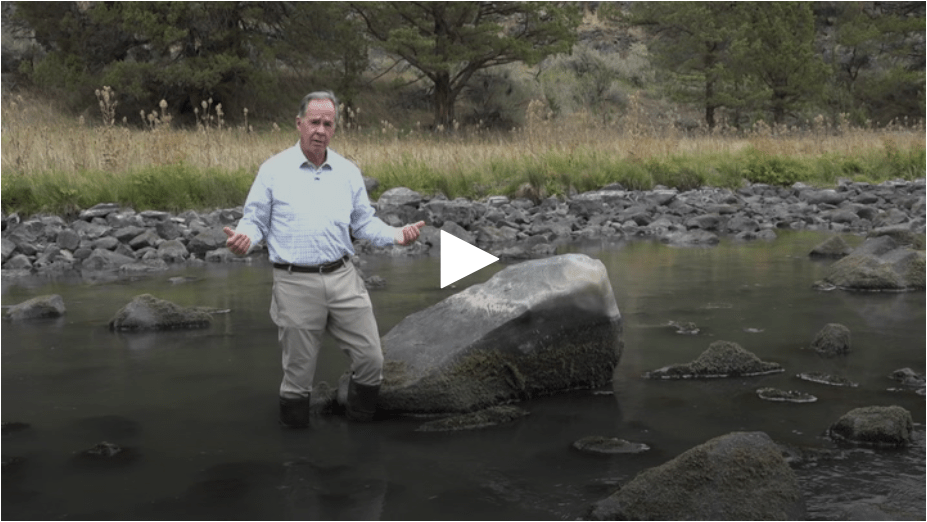
Brooke Snavely of Central Oregon Daily News interviewed me today on the banks of the Crooked River. I don’t know how long the story will be archived on their site, but below is the accompanying text. It’s always a strange experience to see myself on video and to try to understand the thought process behind a fair amount of talking on camera getting edited down to a few seconds. But, Brooke did a fine job of squeezing a lot into a 2 minute story.
Read More »Cue the dirge…

It’s almost time for a funeral for the Wild & Scenic section of the Crooked River. It took a few days, but yesterday evening Ochoco Irrigation District and the Bureau of Reclamation reduced the river below Prineville Reservoir 12 cfs. Today I went to pay my respects and take some photos. It is so sad. Don’t forget, the river below the City of Prineville has been in even worse shape, running at 1 to 2 cfs for weeks*, at a time when over 80 spring chinook have been attempting to move up to spawning grounds. Today I left my office in Bend early and drove to the Prineville Reservoir and then down to the bottom of the Wild & Scenic section. Below are photos, videos, and some commentary.
Read More »Crooked River ramp down underway
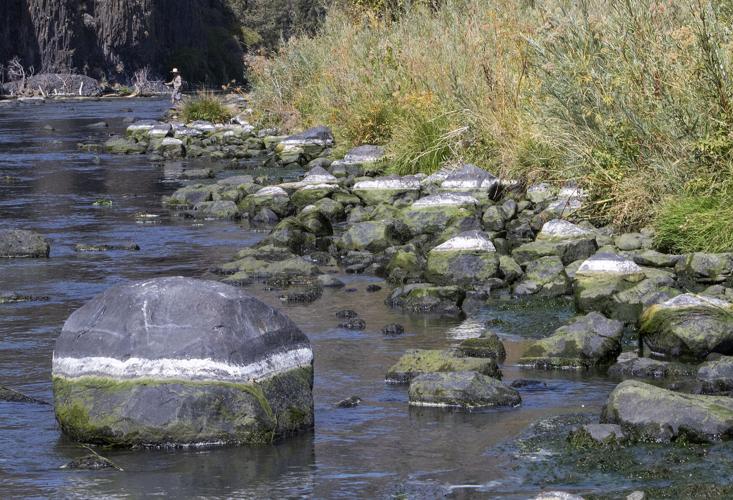
As you probably already know, Ochoco Irrigation District and the Bureau of Reclamation began reducing flows in the Crooked River two days ago. I guess we can be thankful that they did not immediately drop it all the way to 10 cfs so that fish and other aquatic life can try to find deeper pools, but in the long run it will not matter. The river is going too low. Today the Bend Bulletin ran a story on the declining flows that was a little premature in my mind, I am waiting until the flows are fully reduced before heading out to see the damage and take photos. The story contained the normal platitudes from local officials expressing how terrible it is they had to take this drastic action due to factors beyond their control. The typical drivel, once again unchallenged in the article. One comment was particularly misleading, however.
Read More »Crooked River flow update
Yesterday I spoke with Bridget Moran of the US Fish & Wildlife Service, the agency that worked with local irrigation districts and the City of Prineville on the Deschutes Basin Habitat Conservation Plan. Due to the cooler and wetter than anticipated spring, Ochoco Irrigation District was able to move their irrigation shut off date from August 15 to September 15. That’s the good news. The bad news is that the plan is now to keep flows at 10 cfs from shut off until November 1, not October 15.
Read More »My 5 minutes of TV fame (infamy?)
Yesterday morning a client called asking about the “old, scruffy” guy on TV talking about fish the day before. Well, about 3 weeks ago I was interviewed by Central Oregon Daily about the plans to reduce the Crooked River to 10 cfs and realized they must have finally run the segment. At the time of the interview Ochoco Irrigation District and the Bureau of Reclamation were planning to reduce flows around August 15, now they are targeting September 1. Otherwise, I think the interview remains factual. The flows will be reduced until October 15 when the Habitat Conservation Plan requires flows of 50 cfs through the winter. I know of a couple of attempts help alleviate this disaster but at best they are unlikely to succeed.
I would have made this post last night but I was presenting to the local chapter of Project Healing Waters about local water issues. I continue to be pleasantly surprised by people wanting to learn about how water is controlled in Central Oregon and their concern with its mismanagement once they get the facts.
Bulletin article on Crooked River flows
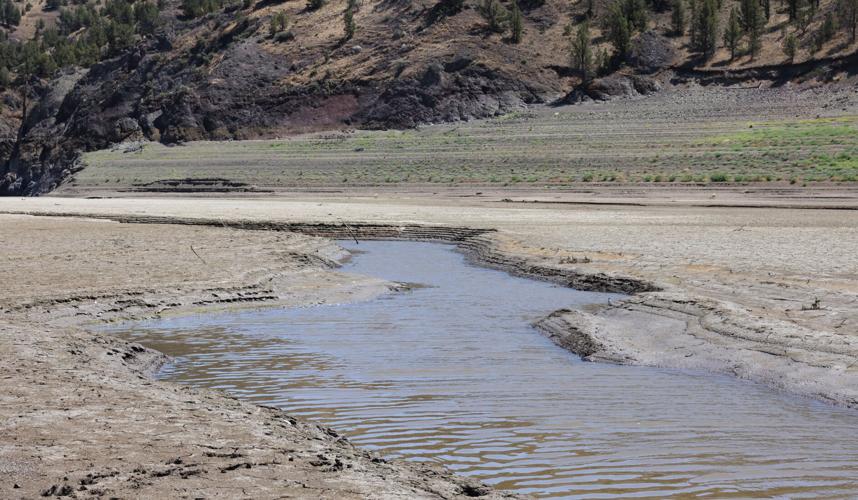
It took three weeks from the time I first alerted the Bend Bulletin on the disaster that is going to happen on the Crooked later this summer, but I am thankful that they did finally run a story. Unfortunately, they did not go into much detail on just how devastating it will be for fish and wildlife. The quote from ODFW, “at this point, the scope of the impacts are unknown and difficult to predict”, is unfathomable. We know what is going to happen and it will be ugly. It seems all the people involved are simply going to watch it happen.
Spring chinook entering the Crooked River
It’s the time of year when spring chinook come into the Deschutes River to spawn. As of yesterday morning, 28 of them have moved through Opal Springs Dam into the Crooked River. Right now there are survivable flows in the Crooked below the North Unit Irrigation District diversion just above Smith Rocks. When the flows out of Bowman Dam are reduced to 10 cfs in August, however, any remaining adults, their eggs, and any fry that have hatched will be in mortal peril.
Some history on the Crooked at 10 cfs
I have heard that folks have been reaching out to the Bureau of Reclamation and elsewhere on the planned reduction of flows in August to 10 cfs in the Crooked River. While the BoR has been unresponsive, public awareness and pressure is a good thing. Keep contacting them and spreading the word! For those of you interested in digging into the details of how this can be allowed to happen, keep reading.
Read More »More on the Crooked at 10 cfs
Brett Hodgson retired from ODFW last year after spending decades as a fish biologist in Prineville and Bend. In my experience, he the most knowledgeable source of information on local fisheries issues and stays active as a volunteer with ODFW. I called him yesterday to get his take on the plans to reduce flows in the Crooked River to 10 cfs next month. It was an interesting conversation, keep reading for more.
Read More »Crooked River disaster on the horizon? UPDATED
Every month a group of local, state, and federal government agencies, Ochoco Irrigation District, the Confederate Tribes of Warm Springs, and others meet to discuss water releases out of Prineville Reservoir into the Crooked River. The minutes of that meeting are distributed to a wider audience, including yours truly. The June 1 minutes were released a few days ago and I had the chance to read them today. If you care about the Crooked River you should be extremely concerned. I encourage you keep reading and to contact Gregg Garnett, the Bend Field Office Manager of the Bureau of Reclamation at ggarnett@usbr.gov or (541) 389-6541 x226.
Read More »First spring chinook of the season
On May 23rd the first spring chinook of the season was passed through the Opal Springs fish ladder. I hope there is enough water in the Crooked River for it. Recently, the river has been as low as 12 cfs below the NUID diversion. For most of the past 2 months, the Crooked has been around 2 to 4 cfs below the OID diversion. I took a photo when I walked across the river near the City of Prineville wetlands project when it was at 4 cfs. As you can see, in the deepest spot the water barely went over the top of my feet.

The Crooked River is an irrigation ditch
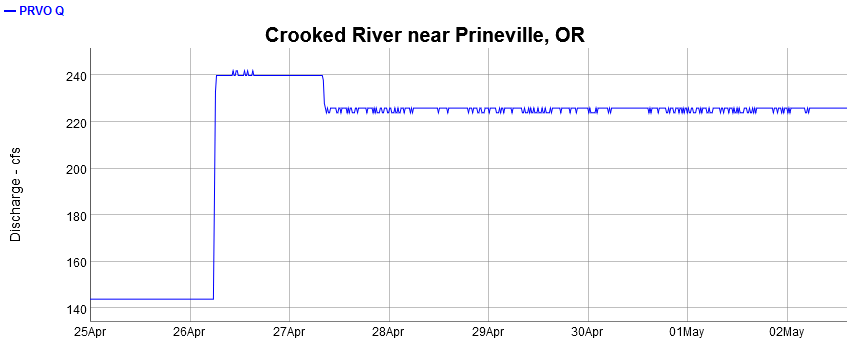
Last week was a typical example of how the Crooked River is managed by the Bureau of Reclamation and local irrigation districts with no concern for fish and wildlife. In only 45 minutes on April 26th, releases from Bowman Dam into the Crooked River rose from 144 cfs to 240 cfs. This started at 5:45 am and ended at 6:30 am. I hope no anglers or wildlife were wading in the river early that morning. Of course, a sudden surge of this magnitude will have stirred up considerable spawning bed clogging sediment.
Read More »Prineville Reservoir and Crooked River flows update
The Bureau of Reclamation has launched a new website tracking Prineville Reservoir water management. For those of you like me who like to dive into the weeds, it’s worth a quick look. The primary content is the letter to “Prineville Reservoir Storage Contractors”. It states that at 27% full, Prineville Reservoir has never been this low at this time of year, is not likely to fill more, and will likely be empty by the end of irrigation season. Most water right holders (“storage contractors”) will receive at most 49% of their water allocations. The big users will receive even less. Ochoco Irrigation District will receive 42% of their water right and North Unit only 27%. This is bad news for irrigators but fishing in the Wild & Scenic section this summer should be fine. The big unanswered question is where will the water for the 50 cfs of winter releases required by the Habitat Conservation Plan come from? Without adequate winter release and a huge snowfall next winter the Crooked River will be in very bad shape. At what point do the needs of fish and wildlife come into consideration?
Irrigation season in full swing, rivers getting killed (again)

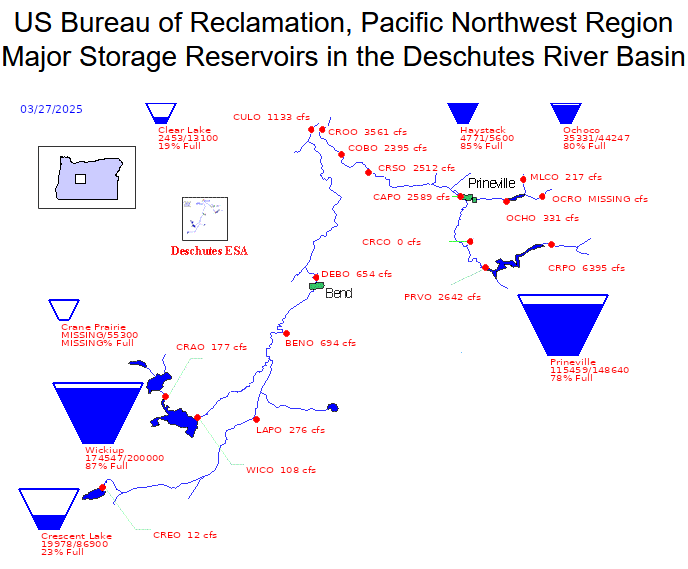
By now I’m sure you are all fully familiar with the Bureau of Reclamation graph of local reservoirs and rivers used to irrigate the high desert. In non-drought years the reservoirs are full early in the irrigation season, but only Crane Prairie and Haystack are near that level today. Haystack is an intermediate reservoir used by North Unit Irrigation District to temporarily hold water from Wickiup and Crane Prairie is kept full early in the season for Oregon Spotted Frog habitat as required by the Deschutes Basin Habitat Conservation Plan. What is less well known is the dramatic change in river levels caused by irrigation diversions, a change which is lethal to many forms of aquatic life.
Read More »Crooked River Forecast
Like many of you, I have been watching the Bureau of Reclamation graph for Prineville Reservoir and the Crooked River. I also receive notes from the monthly planning meetings that occur between the Ochoco Irrigation District and various agencies. I have been waiting to write about this, but a reader asked about it today and irrigation season starts soon, so here’s what I know and what I anticipate will occur.
Read More »Opal Springs Videos
Tomorrow I leave the country for a 10-day “bucket list” fly fishing trip and thought I would leave you with a few brief glimpses of steelhead swimming up the Opal Springs fish ladder. The latest counts are from December 21 through January 10 when 70 fish of all species were detected, including 54 redbands and 4 steelhead. Steelhead returns remain very low, but a few are now in the Crooked River. Flows in the river are well under targets established by the Oregon Department of Fish & Wildlife for healthy habitat, but the river is not dry in places like it was last year when spring chinook arrived. Let’s hope these steelhead find spawning partners and a place to lay their eggs!
Read More »How Facebook and Apple Could Help the Crooked River

Yesterday, the Bulletin published my column on Facebook’s use of water in Prineville and its impact on the Crooked River. Another part of the Bulletin article to which I was responding briefly mentioned the Ingram Meadow Restoration Project in the Ochoco Mountains stating it was a Facebook project that is benefitting our local environment. Clearly, restoring natural habitat is a worthy endeavor to be supported. It is not at all clear, however, what role Facebook played in this US Forest Service project or how it helps offset their significant use of water many miles downstream. If Facebook, or Apple, really want to provide benefit that directly offsets the impact of their data centers on the Crooked River there is a restoration project in their backyard they should fund.
Update: I have been told that Facebook donated $30K to the National Forest Foundation which was then forwarded to the USFS for the Ingram Meadow Project. The total spent on “Meadow and Riparian Enhancement” was $150K.
Read More »Prineville, Data Centers, and Water: There is a Cost
The Bend Bulletin recently reported on an aquifer recharge project by the City of Prineville which has received funding from Facebook and Apple, who use significant amounts of water to cool servers at their data centers in Prineville. Here’s a more complete and balanced explanation of the project and its environmental impacts. Facebook and Apple are trying to reduce their water footprint, but there’s more to the story than reported.
Read More »An Ideal Time to Fish the Crooked River?
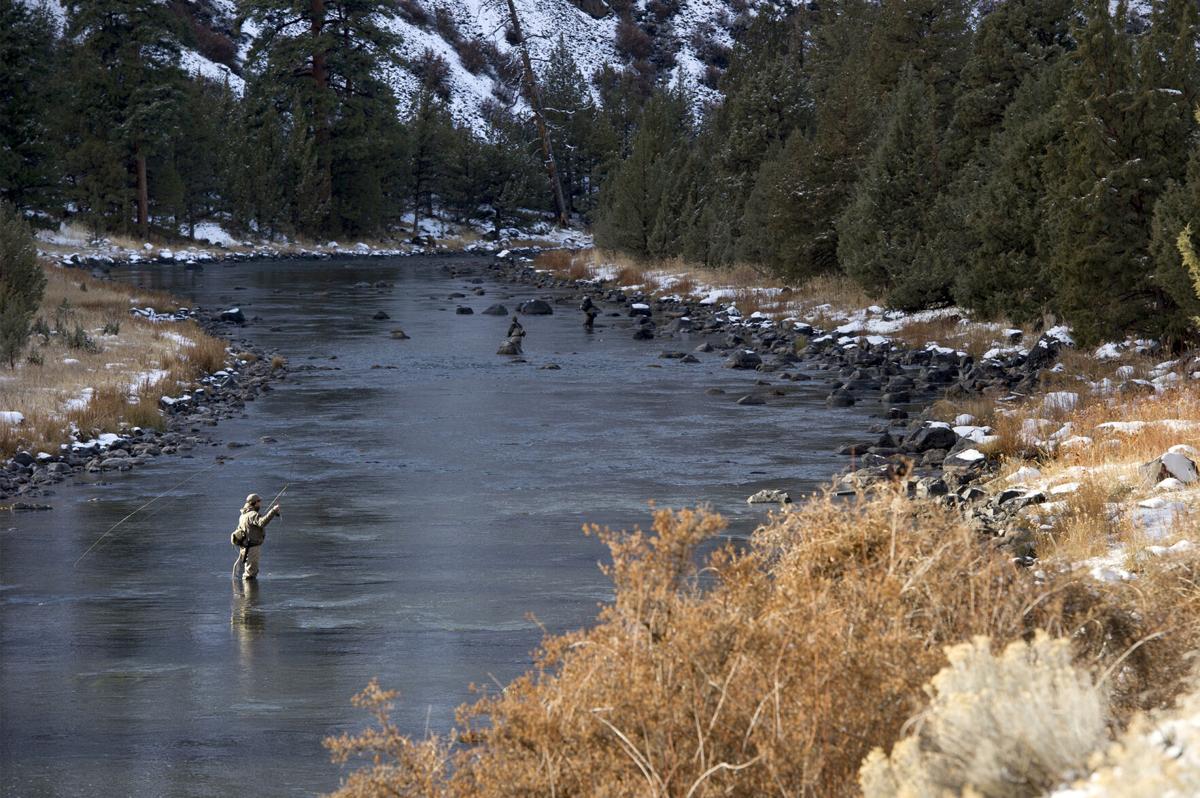
For me, fly fishing is complicated. I consider myself a sportsperson. The point is not to catch as many fish as possible, but to master the art of catching them in a difficult manner, to do it with style and grace, and to mostly release my catch unharmed so that the next angler can have a similar experience. Fly fishing is also my gateway to the outdoors and a calling to conservation. So, when I read “November an ideal time to fish the Crooked River” in the Bulletin, I was simply dumbfounded. How is fishing the Crooked River at 50 cfs, a level that is barely survivable for fish, an honorable pursuit? How is promoting “fishing in a bucket” honorable? It has been many years since I fished the Crooked, and I understand it’s allure for less skilled or less physically able anglers, but I simply cannot understand the promotion of targeting fish at their most vulnerable in cold, low water conditions. Does that make me elitist or conservation minded? I hope the later. I’ll see you on the Metolius and Middle Deschutes for the next 3 months.
Disaster on the Crooked River

The latest newsletter from WaterWatch contains a short item written by yours truly about the extreme low flows on the Crooked River last summer. It’s a more complete version of a post I made last July on the same topic. It’s one of a handful short articles that should be of interest to anglers and those otherwise interested in water in Oregon.
Nearing the End of Irrigation Season

The Bend Bulletin has recently had a couple of good articles on the end of irrigation season which I wanted to comment on. “Deschutes River users brace for annual ramp down of water” discusses how Central Oregon Irrigation District has turned off their water deliveries as they prepare for additional main canal piping. “Water flows to some farmers cut off from irrigation due to drought” discusses how water is being turned on for the next 2 weeks to both North Unit Irrigation District and Arnold Irrigation District. While these are well written articles, and I appreciate the Bulletin’s continued coverage of local irrigation water issues, I believe some clarification and discussion is warranted.
Read More »The Endangered Species Act is Not the Problem
A few days ago the Bend Bulletin ran an opinion piece from a local farmer that partially blamed the Endangered Species Act for irrigator water shortages. Below is the response I submitted. Let’s see if they print it.
7/29/21 UPDATE: That was fast, it’s in today’s paper.
The Bulletin recently ran a guest column from a Central Oregon farmer asserting that the Endangered Species Act is partly to blame for current water shortages. Many local farmers need more water, but the column is written from a perspective that does not hold up to objective analysis.
Read More »Crooked River at 5 CFS?

Brett Hodgson, recently retired Deschutes District fish biologist at the Oregon Department of Fish & Wildlife, sent me this photo taken at 8:15 this morning of the Crooked River at Smith Rocks. He estimates the river is at 5 CFS! The air temperature is supposed to reach at least 90 degrees today. You are looking at what will soon be a dead stretch of river, if it is not already. You could walk across it without getting your feet wet.
So much for anadromous fish reintroduction. Over 60 adult spring chinook salmon have gone through the fish ladder at Opal Springs to be faced with this.
And so much for the benefits of taxpayer funded canal piping. Some of that piping was supposed to increase flows in this stretch of the river. In fact, the minimum is supposed to be 10 CFS, which the river is not at, and 10 CFS is not enough to support fish in any event.
“Record Chinook Returns”

I have made a few posts about extremely low water in the Crooked River below Prineville and its impact on fish, including spring chinook returns this year. (See here, here, and here.) I was going to wait until the end of July when spring chinook season ends to say more, but the Bulletin ran a story about it today where I am quoted, so here’s more to fill in the gaps.
Read More »More Spring Chinook Going Nowhere
Due to irrigation withdrawals, the Crooked River is currently so low as to be impassable around Smith Rocks and the City of Prineville. Once the river reaches the Crooked River Ranch golf course, it is recharged by cold, clean water from a series of springs to the extent that it actually resembles the Metolius River by the time it reaches Lake Billy Chinook. As a result, the bottom stretch of the river has sufficiently high quality water to attract spring chinook through the fish ladder at Opal Springs Dam just upstream from LBC. As of today, 12 chinook have passed through the ladder. That’s the good news. The bad news is that they won’t get far. Let’s hope they can find places to spawn in a very short stretch of water.
Opinion Piece in the Bend Bulletin
The Bend Bulletin ran a version of my recent posts about flows in the Crooked River today. They titled it, Take a new look at water distribution in Central Oregon.
Spring Chinook, the Crooked River, and the HCP
Here’s more on the extreme low flows on the Crooked River which is currently at 9 CFS below Prineville. As of yesterday, 3 adult spring chinook have swam through the fish ladder at Opal Springs near the mouth of the Crooked River. They won’t get far, however, as the river is impassable for fish their size not far upstream. Below are a couple of photos of the river a little below the North Unit Irrigation District diversion near Smith Rocks. Why doesn’t the Habitat Conservation Plan require flows needed for these reintroduced fish? Probably because they are not yet listed as endangered species in the Deschutes Basin, but steelhead are, and their fry need higher, cleaner flows to survive.
Read More »Crooked River 2021 Flows

We can now make a prediction about how the Crooked River will look for the remainder of the year. The executive summary is that the Wild & Scenic section below Bowman Dam, where most anglers spend their time, down to the City of Prineville (CoP), will have good flows during irrigation season and will have low, but survivable flows in non-irrigation season. Below CoP is another story. Flows below CoP will be extremely low, lethally so at times, during irrigation season but then improve during non-irrigation season. Read on for a detailed explanation.
Read More »No, We Are Not Moving Fast Enough On Water
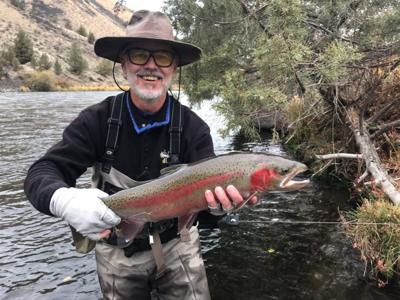
My latest column appeared in the Bend Bulletin today. Once again, I appreciate their increased coverage of local conservation issues and occasionally letting me submit something. If you don’t have a subscription or have used you your free views for the month, here’s the text.
The Bulletin recently ran a column titled “Central Oregon Crossroads: Are we moving fast enough to protect our waterways?”. I always appreciate water articles and commentary, but the column did not address numerous local issues. Here’s a brief, partial overview.
Read More »Crooked River Flows & Management
I have been a member of Central Oregon Flyfishers since 2004. Like so much else in Central Oregon, COF has grown considerably since then, mostly with new members from out of the area. At last month’s COF meeting a question was asked about fishing the Crooked River in the winter during low flows which made me think it was time for another overview of how Bowman Dam and the Crooked River are managed. Here’s a quick recap.
Read More »Attack on Fish Passage Requirements
Yesterday, Ochoco Irrigation District notified the Federal Energy Regulatory Commission that they were surrendering their preliminary permit to install a hydroelectric facility at Bowman Dam. Simultaneously, Prineville Representative Vikki Breese Iverson introduced House Bill 2610 which could eliminate statewide fish passage requirements for many dams. I simply don’t understand this lack of concern for our environment, rivers, fish, and wildlife. Yes, the cost of providing fish passage at Bowman was projected to be high, but so is canal piping which is getting done with little financial contribution from the applicants. Or, the applicants could provide some other net benefit (e.g., habitat restoration, increased flows, pollution reduction) that would mitigate the lack of passage. OID, the City of Prineville, and Crook County are looking for an easy, one-sided solution to the detriment of the long term environmental health of Oregon.
Why are salmon and steelhead on the path to extinction?

The Bend Bulletin recently published an article from the Associated Press titled “Study: Ocean conditions, not dams, reduce salmon runs”. This is misleading reporting of the original study, “A synthesis of the coast‐wide decline in survival of West Coast Chinook Salmon”, published in the Fish and Fisheries journal.
The research study argues that the most prized salmon and steelhead populations along the west coast of North America are in decline, often dramatically so, and that the reasons are complex. Dams are not the sole culprit. This can be a controversial statement in many environmental circles, but it is true. It is well known that anadromous fish are declining in river systems that are not impacted by dams as well as where dams are present. This is not an either-or proposition, however.
Read More »Crooked River at 47 CFS
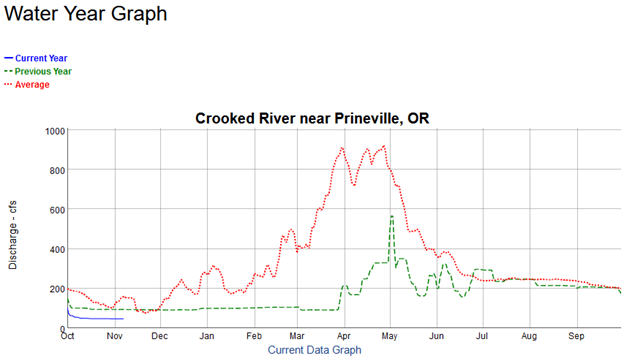
A reader recently contacted me concerned about low flows in the Crooked River. As I have written about in the past, Prineville Reservoir is currently being managed by Ochoco Irrigation District and the US Fish & Wildlife Service to release 50 CFS during the winter (non-irrigation season). In my opinion, this is in violation of the 2014 Crooked River Act. At the beginning of the irrigation season there was more than enough water in the “fish bucket” to meet the Act’s 80 CFS target over the winter. Worse, they are not even releasing 50 CFS as the river has been at 47 CFS for some time now. 3 CFS might not seem like much, but OID is currently asking to spend tens of millions of dollars of taxpayer money to add 4.8 CFS. Once again, fish, wildlife, and taxpayers are losing.
Opal Springs Videos!
I upgraded my WordPress subscription so I could add some cool videos of fish passing through the Opal Springs ladder at the mouth of the Crooked River. Here’s just a sample.
Bowman Dam Fish Passage Waiver Denied!

After almost four hours of testimony and discussion, the ODFW Commission denied the request by Ochoco Irrigation District, the City of Prineville, and Crook County to provide a waiver for fish passage! Get more background information here. I certainly hope that the applicants follow the advice of the Commission and come back with an improved application. Clearly, adding a hydro facility to Bowman Dam has real benefit, but there needs to be real benefit to fish as well.
Final Decision on Bowman Dam Fish Passage this Friday
As I wrote about here and here, Ochoco Irrigation District, the City of Prineville, and Crook County would like to add a hydroelectric facility to Bowman Dam (Prineville Reservoir) without providing fish passage. This would violate the law so they are asking the Oregon Department of Fish & Wildlife for a waiver. The ODFW Commission will make their ruling this Friday. You can find the meeting agenda here, and sign up to testify (via Zoom) here. Public testimony at prior hearings has been overwhelming against providing a fish passage waiver but the applicants will make their best case for it on Friday so a strong showing by conservationists and fish advocates is essential. Lend your voice to fish, it’s not painful at all.
Ochoco Irrigation District Canal Piping Post – Another Boondoggle?
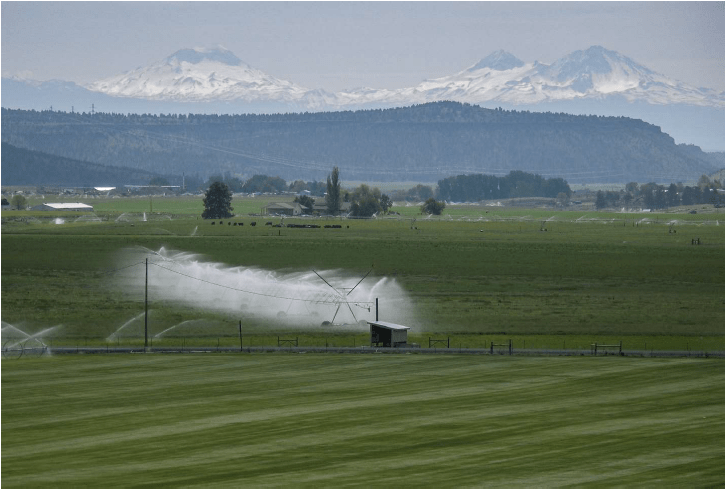
Ochoco Irrigation District is the latest in Central Oregon to apply for federal funding to upgrade their water distribution system. Details of the proposal as well as information on how to submit comments by September 30th are online. The “Draft Watershed Plan – Environmental Assessment” (Draft-EA) is 155 pages long but easy to read. I encourage you to go through the materials yourself and come to your own conclusions, but here are my comments. Like the previous proposals from other local irrigators, it’s a mixed bag. The common belief is that canal piping is good, and in theory I agree, but the devil is always in the details.
Read More »The Crooked River Act, 6 Years Later

At the end of 2014, the Crooked River Collaborative Water Security and Jobs Act was passed. Commonly known as the “Crooked River Act”, I was a minor participant in the negotiation of this controversial legislation. Many people whom I respect continue to believe that the Crooked River Act was a giveaway to irrigators and a loss for fish and wildlife. I disagree with them, but the way in which the bill is being implemented does not meet the spirit in which it was negotiated. Read on for an overview of the bill, how it is working, how it is not, and why this is an even more important topic given the impending release of the Deschutes Basin Habitat Conservation Plan.
Read More »Local Reservoir and River Levels

Here’s how our local reservoirs and rivers look as of the end of the day yesterday (click here for a direct link). Crane Prairie still has a lot of water as it is held fairly constant until late summer to maintain endangered species habitat. Haystack is nearly full as it is intermediate storage for North Unit Irrigation District. NUID’s main storage is Wickiup which will most likely be empty before the end of irrigation season. Prineville Reservoir is managed for both irrigation and fish. As of August 5th, it has 41,820 acre feet of irrigation water and 23,380 acre feet of “fish water”.
Read More »2020 Deschutes Fisheries Workshop Recap
I have looked forward to attending the annual Deschutes Fisheries Workshop for many years. It has been the place to hear the latest, best available science on what is happening in the Deschutes River, some of its tributaries, and anadromous fish reintroduction efforts. I found the online event yesterday to be disappointing, however. Part of that is due to the lack interaction with others in the hallway, during a meal, or at the bar. The organizers are not to blame for that, they have no control over the pandemic, but they could have provided a lot more content. Here’s my summary and criticism of the 26th annual meeting
Read More »Wonky: Bowman Dam / Crooked River Water Accounting
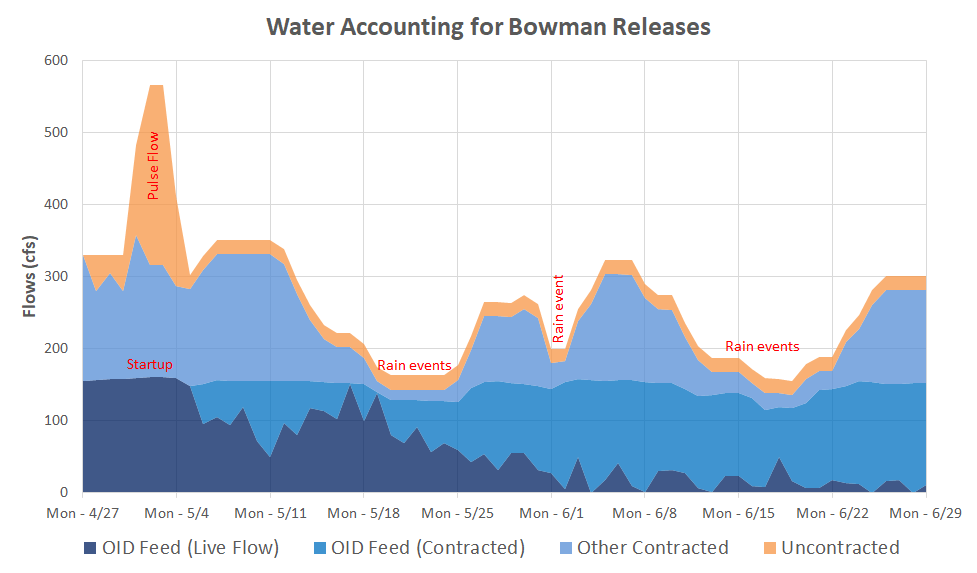
I’m on the email list that discusses water releases from Bowman Dam into the Crooked River. You can get more details by reading prior posts on the topic (see the Crooked River section), but the executive summary is that the water is supposed to be released for irrigators as well as the “maximum benefit” of fish. How that actually occurs is the subject of constant discussion. The latest email contained the graphic above that really illustrates the operation well.
Read More »Bowman Dam Fish Passage Waiver Public Comments
All public comments pertaining to the requested fish passage waiver are part of the public record. I requested a copy of them, which you can see here. There is some grey area as a few were not perfectly clear, but by my count there were 171 letters in opposition to the waiver and 12 in favor. (In other words, the overwhelming majority asked that fish passage be provided.) I thought the letters made for interesting reading and recognized many of the writers. The final decision is scheduled to be made in September.
My Email to ODFW Opposing the Fish Passage Waiver
For what it’s worth, here’s the email I sent to ODFW yesterday:
I oppose providing a fish passage waiver for the proposed hydroelectric plant at the base of Bowman Dam. While the cost of installing a ladder may be prohibitive, the proposed mitigation measures do not come close to providing a greater benefit to fish than opening up 500 miles of habitat and reconnecting fish in the upper Crooked River with fish in the lower Crooked River as well as other upper Deschutes Basin waterways. Further, a 50-year FERC license would preclude passage for the same amount of time.Read More »
Fish Passage Waiver at Bowman Dam? Not so fast.

Bowman Dam was completed by the US Bureau of Reclamation (BoR) in 1961, damming the Crooked River and creating Prineville reservoir. It was built to protect development downstream from flooding, including the City of Prineville, and to provide water for Ochoco Irrigation District (OID) who operates the dam. While these are worthy goals, Bowman Dam has also caused significant environmental damage. OID, Prineville, and Crook County would now like to add a small hydroelectric facility to the base of Bowman Dam and are asking for a waiver to the State of Oregon requirement that fish passage be provided at dams undergoing significant changes. This is a complex issue, below are my thoughts. The waiver application, supporting documents, and analysis by the Oregon Department of Fish & Wildlife can be found here. Public comment on the waiver application is being accepted until June 22nd.Read More »
Largescale Suckers
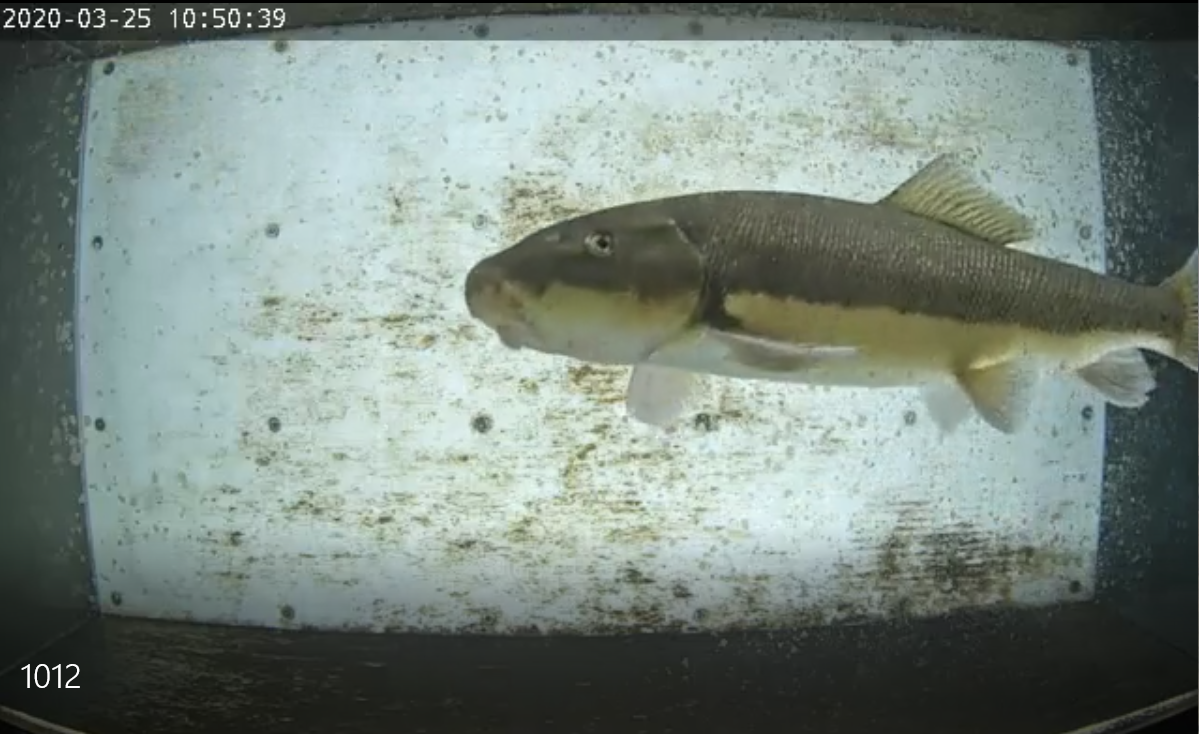
The latest report from Opal Springs says that over 1,000 largescale suckers moved through the fish passage the last 2 weeks of March. I don’t know anything about these fish so did some web searches and asked Brett Hodgson, ODFW Deschutes District Fish Biologist, about them. It turns out that some people like to fish for them, and they taste good. Brett emailed me that “suckers historically were an important source of protein for Native Americans in periods when salmon were not available”. I may have to target them with a sinking line and an egg pattern someday.Read More »
CTWS Comments on the HCP and EIS

I have read many of the substantial comments on the Draft Deschutes Basin Habitat Conservation Plan and associated Draft Environmental Impact Statement. The comments from the Confederated Tribes of Warm Springs illustrate just how tangled an issue this is. Like many others, the Tribes are extremely critical of the draft HCP and EIS, but in a unique way. While most critical comments ask for more water more quickly in the upper Deschutes in the winter, the Tribes want LESS water than proposed. Keep reading to understand why.Read More »
Good Outlook for the Crooked River this Winter
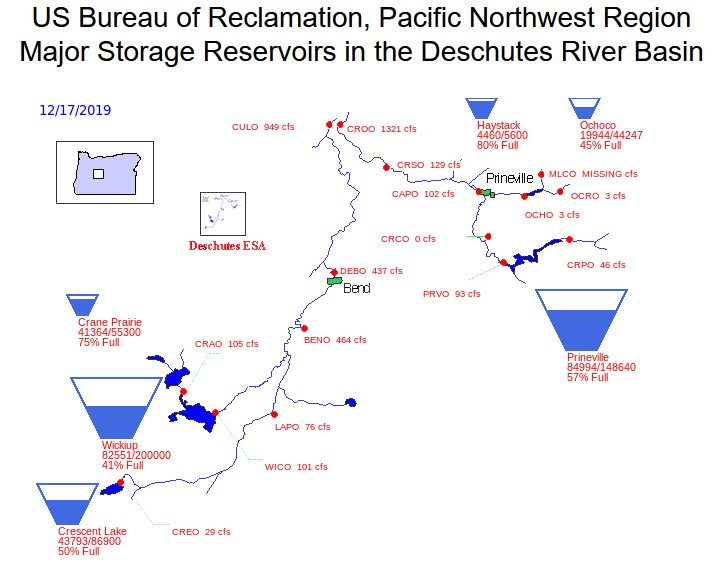
While the winter has started out somewhat dry in Central Oregon, things look good for the Crooked River this winter. Prineville Reservoir was not drawn down to very low levels over the summer and is currently 57% full. The majority of that is “fish water”, meaning it is not earmarked for irrigation use, and can be released for fish and wildlife. 93 cfs is currently being let out into the Crooked, which provides reasonable habitat for fish, and this amount should be maintained throughout the winter. Some fish water may even be left over. Of course, higher flows will likely occur if the reservoir completely fills over the winter. So, right now it looks like next spring and summer could be good for fishing on the Crooked.
Opal Springs Passage is Working!
The new Opal Springs fish ladder became operational on Nov. 15 and an automated fish detection system was installed 4 days later. In the first 13 days (11/19 to 12/1) 23 trout, 28 whitefish, and 3 steelhead have been counted. That’s an excellent start.
Opal Springs Ladder in the Bulletin
The Bend Bulletin ran a story today on the Opal Springs fish ladder. It’s worth a quick read. I’m glad to see the new ownership of the local paper paying more attention to environmental news.
Video of the First Steelhead
Here is a short video of the first steelhead in the new Opal Springs fish ladder. First volitional passage in almost 60 years. So very cool.
 Central Oregon Informed Angler