I have written about global warming’s impact on the ocean off the coast of Oregon as well as on local steelhead and salmon populations. To put it mildly, warming, acidification, and oxygen deficiency have not been beneficial. At the same time, some far northern locations, close to the arctic, have seen record runs of some species. Bristol Bay is a good example. Here’s a report in the journal Science which helps quantify all this. The bottom line is that ocean fish populations are clearly declining overall due to global warming.
Category: General
The Osprey and a Critique
The latest issue of The Osprey is now available. If you like to read scientific articles about steelhead and salmon conservation, mostly in the Pacific Northwest, then this is the journal for you. I encourage you to subscribe and help keep them going. This issue has a couple of articles that once again illustrate the peril facing anadromous fish in many PacNW river systems. It also contains an article on the lower Deschutes River which I found problematic. Read More »
Brother of the Angle
I recently finished reading “The Compleat Angler” by Izaak Walton, who has been called the Father of Fly Fishing. First published in England in 1653, with revised editions until 1676, reading The Compleat Angler was a slog at best. Written near the time of Shakespeare, but without the Bard’s skill, it deserves its modern reputation as tedious. That being said, it was absolutely fascinating to read how much was known about angling 366 years ago.Read More »
My Bull Trout Fishing Prediction

This is not a fishing blog, but every now and then I will post something along those lines. For a few years now I have been chasing bull trout on Lake Billy Chinook using fly gear. It’s challenging but can be rewarding. Above is a photo of one of my sons with a nice bull trout. There are a lot of variables at play, but it looks like we could have a good and early season. Here’s what I have been looking at. Read More »
Willamette Falls Fish Ladder

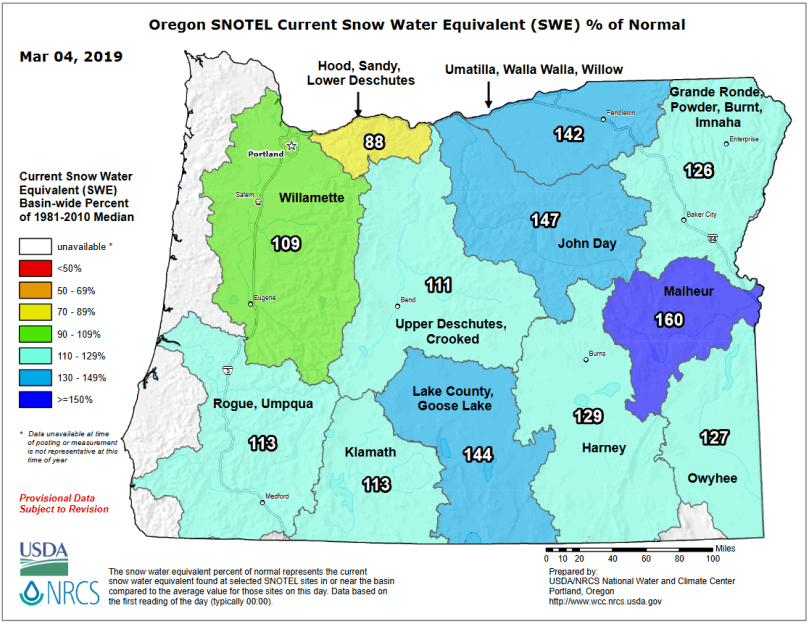
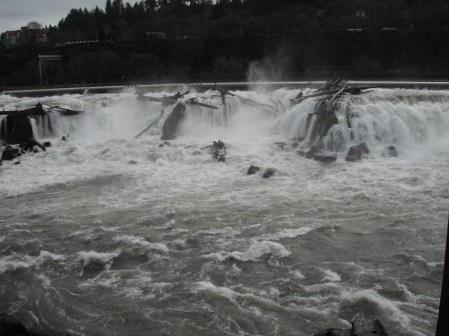
Last week I had the opportunity to tour the Willamette Falls fish ladder as a member of the ODFW Restoration & Enhancement Board. There has been extensive coverage, including posts on this blog, about sea lion predation on anadromous fish at this ladder, to the extent that steelhead runs were at short term risk of extinction. ODFW is now euthanizing the most problematic pinnipeds. Less publicity has been given to the fact that the fish ladder itself is in danger of structural failure.Read More »
Crooked River Water Outlook
Here is a recent report from the Bureau of Reclamation on the water outlook for Prineville Reservoir. As you can see on page 3, a few days ago the reservoir was 35% full and flows into the Crooked River were only 49 cfs (47 cfs today), which is below the target set by ODFW for fish needs and the 80 cfs target in the Crooked River legislation. In summary, the BOR presentation implies that the outlook is not promising for the reservoir to fill which means flows into the Crooked River next winter after irrigation season ends will also likely be low. Keep reading for some commentary on the presentation prepared by BOR.Read More »
Bulletin Column on Water Rights
Yesterday George Weurthner had a worthwhile letter to the editor in the Bulletin on water rights. I agree with his comments, here’s my 2 cents. Over 100 years ago, when Central Oregon was mostly unsettled wilderness, the state gave away water rights, not water ownership which remains with the public, in an effort to create a local, agricultural based economy. Today, our area is booming and agriculture in Deschutes County is a minor and decreasing component of our economy. Nevertheless, irrigators continue to divert 90% of the water in the upper Deschutes Basin. It is well past time to reallocate the public’s water using a modern definition of beneficial use. It is possible to maintain water rights for irrigators who are truly using it for agriculture, provide for other irrigators willing to pay a market price, while supporting the growth of our modern economy, ensuring municipal water supplies, and restoring our public water ways.
Two Good Reads
As I say in the “About” section of this blog, I believe that WaterWatch is the most important water conservation organization in Oregon. They have done amazing work to restore flows, breach dams, and protect groundwater. Their latest newsletter is well worth reading. The Osprey is an excellent, research-based publication for anyone interested in anadromous fish in the Pacific Northwest and beyond. The September issue is filled with great data, including the statement that the full cost of every hatchery steelhead returning to the Columbia Basin is on the order of $1,000, while degrading the opportunity for wild fish to recover. I have read this issue a couple of times now and underlined much of it.
How will climate change affect local rivers?
Today the Bend Bulletin ran a story on climate change’s impact to local rivers and I was one of the people quoted. I am always frustrated with the experience of spending time discussing an issue in depth and seeing cursory coverage as a result. I respect work the reporter does for the paper and understand that space is limited but there is so much more to say. Oh well. The good news is the article does capture the big picture and hopefully adds to the general awareness of global warming’s current local impact, not sometime in the future. That being said, I do have one quibble with the story.Read More »
Potentially Good News for the Crooked River?
For years, the Crooked River has been plagued by periodic fish kills. There have been two culprits: sustained low flows, especially when combined with freezing temperatures in the winter, and excess total dissolved gases. TDG is not as well known as low flows but it can be equally deadly. A solution in the form of a new hydroelectric facility may be in the future.Read More »
Bend Bulletin Article on Crooked River Flows
A reporter at the Bend Bulletin saw my post on the potential for a fish kill on the Crooked River this winter and wrote this article. If you’ve ever been quoted for an article you know how it can be a frustrating experience. So it almost goes without saying that I would have written the story differently but I think the reporter did a good job overall of capturing the big picture of what is currently happening on the Crooked River and the challenges it faces this winter.
Steelhead Returns and a Climate Change Denying Environmental Group

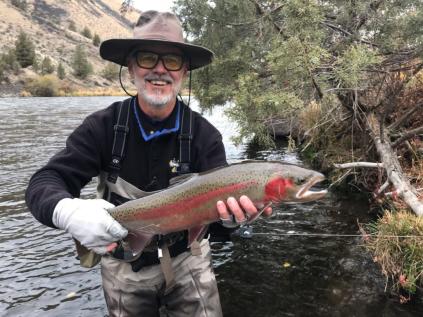
October through the end of the year is one of my favorite times to fish the lower Deschutes River. The crowds are gone and the trout are still there. On Halloween a friend and I had a good day. One of the trout I landed measured at just under 18”. The bonus was this hatchery steelhead which was a thrill to land using trout gear. Nevertheless, the outlook for wild Deschutes steelhead remains bleak.Read More »
Another fish kill coming to the Crooked?

As Central Oregon anglers know, fish populations in the Crooked River can wildly fluctuate. When there is adequate flow for a few years the fishing can be excellent. On the other hand, a variety of factors including low flows combined with freezing temperatures can create massive fish kills. The last of these events happened in the winter of 2015-2016 when trout populations dropped from 1,383/km to 185/km, the lowest ever recorded. Based on current water management plans, such a kill could happen again this winter.Read More »
The end of local seafood?
I have written about ocean warming and the dramatic decline in steelhead and salmon populations. Most recently, I posted about commercial salmon fishing belatedly being declared an official disaster. Here’s a related NOAA report and a State of Oregon report on ocean acidification. Scientists have had a clear understanding of global warming for 40 years but we continue to study the problem. I just don’t get it: you don’t study fire while watching your house burn down.Read More »
Deschutes Wild Steelhead Update
Unfortunately, as of the end of September things still look pretty bleak for wild fish this season. The trap at Sherars Falls has captured a total of 44 wild steelhead. Only 3 of these have made it to the the trap at the bottom of the Pelton Round Butte complex (Lake Billy Chinook, etc.). Two of those are actually hatchery steelhead that were released above Lake Billy Chinook but did not have their adipose fins clipped. As I detailed in a series of posts starting here, these fish could be on a path to extinction in the not too distant future.
Salmon Now Officially a “Disaster”
The US Secretary of Commerce has declared that commercial salmon fishing along the west coast from 2015 through 2017 was a disaster. (It’s no better this year and steelhead are also in critical condition.) The determination provides economic assistance for commercial fishing communities. This recognition is welcome but it seems to me that it would be equally important to fix the root causes. Without this the desired “rebound” will not occur.
More on Wickiup
Last week I sent an email to the Bend Bulletin pointing out that their coverage of low levels in Wickiup Reservoir was inaccurate when it assigned partial blame to the endangered Oregon Spotted Frog. Flows for the frog out of Wickiup into the upper Deschutes River are in the winter only and Wickiup was completely full when irrigation season began. I was happy the Bulletin published a new article today that correctly identifies last winter’s low snow pack as the culprit for low water levels, but this new article also fails to address another important issue. Why where no mitigating actions taken? There are strategies that could have reduced the draw down. Read More »
Why was Wickiup drained dry?
Wickiup and Crane Prairie reservoirs on the upper Deschutes River were constructed to hold water for irrigation releases from Bend to Madras. Wickiup is currently at its lowest level since 1952, and it may get lower. As of September 20th Wickiup is only 2% full. Until recently, Wickiup had some of the best kokanee fishing in the state and excellent trout fishing as well. This popular fishery is now gone.Read More »
Deschutes Wild Steelhead Projection
Today I talked to the ODFW biologist in charge of the lower Deschutes. He said that it was too early to know how many wild steelhead would return this season but if he had to guess it would be similar to last year, which was one of the lowest on record. He was optimistic, however, that the population would recover if conditions improved. As I have discussed on this blog, that’s a very big if and trend is not encouraging. He acknowledged that less angling pressure would benefit wild fish but thought that I went too far to state that it was immoral to target them. While I really want to fish the lower Deschutes, for now I am going to focus on coastal rivers where counts are at or above their 10 year averages. Hopefully, counts on the Deschutes will significantly climb over the next couple of months.
How does catch and release affect steelhead?
I was wandering around various angling conservation websites and came across “How does catch and release affect steelhead?” on the Wild Steelhead Coalition website. It was a summary of a study done on the Bulkley River in British Columbia. The primary takeaways for me are that I will continue to avoid steelheading on the Deschutes for now and I need to start using a net. Like many fly anglers, I land a steelhead by bringing it close enough to grab by the tail before removing the hook. The study showed that “tailed” fish had higher levels of stress than netted fish.Read More »
Another Environmental Law Being Ignored
Long time fisheries activist Jim Myron, now working with The Conservation Angler, wrote to inform me of an Oregon state law that is relevant to my most recent post about the immorality of fishing for steelhead on the Deschutes at this point in time.
He states:
ORS 496.012 requires the state to “prevent serious depletion of any indigenous species…” This has gone way beyond serious depletion and we are looking at extinction on the horizon.
Deschutes Steelheading: Now a Moral Issue?
As local anglers know, the 2017/2018 steelhead season was bleak, adult returns were one of the lowest on record. After some initial optimism for at least a modest rebound, this season now looks to be even worse. A few days ago Oregon and Washington lowered their forecast for returns and closed the Columbia River and parts of some tributaries to steelhead fishing for the rest of the year. We anglers are now faced with a moral issue: even if most of the Deschutes remains open, can we afford to further stress and potentially kill the small numbers of wild fish that do return? See below to make your own informed decision.Read More »
Lower Deschutes Fires

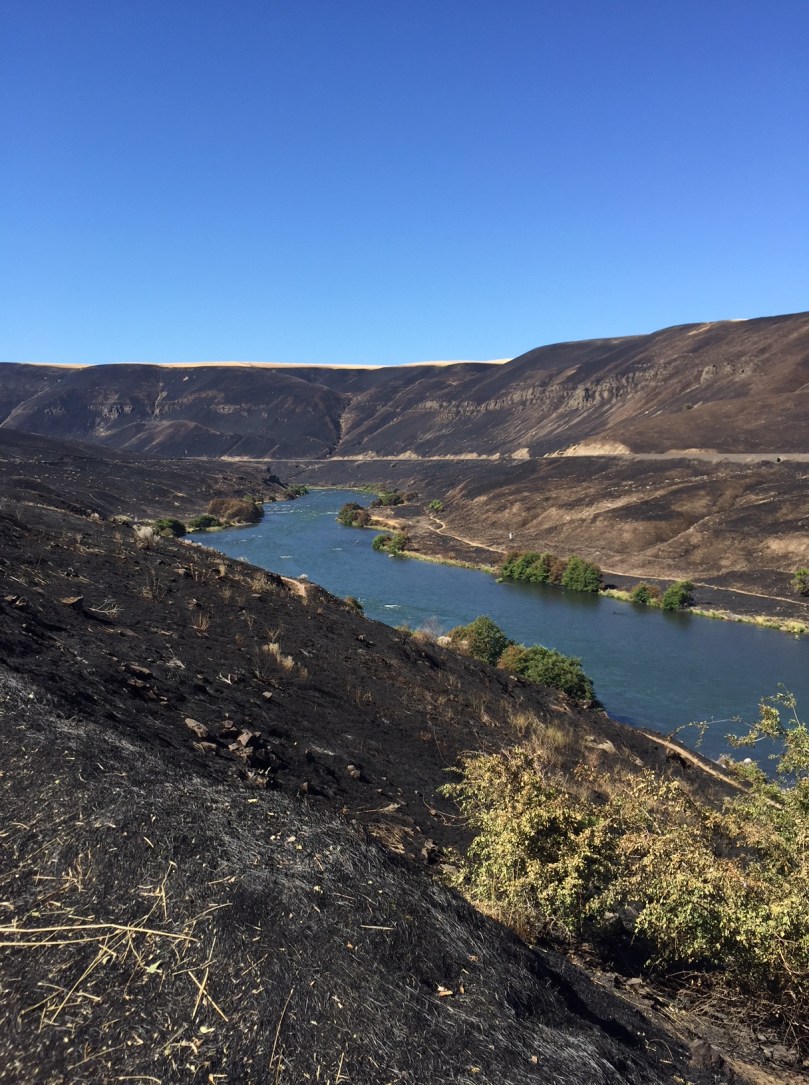
Fires on the lower Deschutes this year are the worst in memory. I have been told that it looks like this from Mack’s Canyon almost to the mouth as well as in many places above Mack’s. The main campgrounds above Mack’s along the dirt road have been saved but most of the campgrounds below are burned to the ground, including many of the outhouses. It’s going to be tough camping for floaters for a while. The good news is that early summer steelhead numbers are reasonable although the river temps in the lower most stretches are too hot in the afternoon to safely land fish. The sick joke is that it’s time to get out your single hand rods again as there is plenty of room to back cast.
Crooked River Trout Survey

Not long ago I was one of the volunteers who helped ODFW with their annual trout survey on the Crooked River. As reported in The Bulletin, it appears that trout numbers have rebounded from their recent record lows and are now up to 3,500 a mile. This is welcome news, but it is only part of the story.Read More »
Bull trout redd survey
I had a request to post the bull trout redd survey data. As you can see, there has not been a significant drop recently. There is also hydroacoustic data that shows a continued steady population of bull trout in Lake Billy Chinook. The big drop in 2006 is correlated with a drop in the kokanee population, the bull’s primary food source, after the bulls became too numerous to be supported by the ecosystem. Note that the redd count has stayed fairly constant since then and at a level above pre-SWW levels.
Lower Deschutes fish populations & health
At last week’s fisheries workshop, ODFW gave their annual report of fisheries population and health for the lower Deschutes. Since the 1970s they have been electrofishing the same stretches from Warm Springs to Jones Creek. As reported in past years, trout continue to be in excellent health. Condition factors were good before operation of the SWW and they are at least as good now. If anything, the fish appear to be growing faster and are larger.Read More »
Bull trout and kokanee in Lake Billy Chinook

Slightly off topic for this blog, but I was frustrated with multiple fly fishing trips for bull trout at LBC this spring. The photo is of one of my sons from last spring when big fish like this were common. This spring they were nonexistent. I contacted the fisheries biologists at PGE and they said they had no evidence of a population drop and shared a chart of redd spawning surveys in Metolius tributaries which continued to show a robust population.Read More »
North Fork Crooked trout survey
Most Central Oregon anglers are familiar with the Wild & Scenic section of the Crooked River below Bowman Dam. Of course, the Crooked flows into Prineville Reservoir as well but based on my experience few outside of Crook County have spent much time there. The North Fork of the Crooked does not provide the same abundance of fishing as the Wild & Scenic section, but it flows through a beautiful area of the Ochoco Mountains. Prior to the construction of all the dams below (Bowman, Opal Springs, and the PRB complex), this section of the river was prime spawning habitat for anadromous fish. Big Summit Prairie is also nearby, worthy of a visit on its own. The last time I visited the North Fork my wife and I saw one of the biggest bears I have seen in Oregon, it was a brownish red color and seemed undisturbed by us as we watched it for some time. The North Fork provides habitat for an important strain of wild, native redband trout. ODFW is planning a electrofishing survey of the North Fork and could use some volunteers, this would be a great opportunity to help and see some beautiful country that is not very far away.Read More »
Climate changes in Montana (and locally)
I was recently sent a link to an interesting article about climate change’s impact on fly fishing in Montana and the continued denial of the science by so many, even the local Trout Unlimited chapter. The article is part of a series by Inside Climate News. It was worthwhile reading and also reminded me of anglers venting about PGE causing changes on the lower Deschutes and not considering the undeniable changes we have seen in our local climate over the past few years. Clearly, the SWW has made an impact on the river, but so has a series of droughts, low water years, and year after year of record hot summers. Next week is the annual 2-day Deschutes fisheries workshop and I look forward to hearing the latest science on the lower D. Read More »
Three days on the lower Deschutes

Is TID pulling a fast one?
As I discussed in this post, Tumalo Irrigaion District is asking taxpayers to pay the full $42M+ cost of piping their irrigation canals. They claim in their Draft Environmental Assessment that piping will conserve about 48 cfs (page xxvii) which they will return in-stream. BUT, page D-20 of the appendix contains a table showing increased water deliveries to irrigators after piping is complete. Where does this water come from? Why is it not being returned to the river? Why is on-farm conservation not being pursued to REDUCE usage? You have until May 22 to submit your comments.
Fact checking…
Once again, I was criticized for making statements that readers believed to be erroneous, this time in my post on Tumalo Irrigation District’s piping plans. I did provide footnotes and links to source material but I guess that was not enough. Today, a slightly shorter version of the post was published in The Bend Bulletin after being independently fact checked by them. I did have to add the word “most” to one sentence, but otherwise the only changes were for brevity to fit their 650 word limit. We can all have our own opinions, but we can’t have our own facts.
Who should pay for irrigation canal piping?
Central Oregon Irrigation Districts have spent hundreds of millions of taxpayer dollars piping their canals. They plan to request hundreds of millions more [1]. A current example is Tumalo Irrigation District’s application for funding [2] their next piping phase which will cover 68.8 miles, take 11 years to implement, and is expected to cost $42,689,000, all paid by taxpayers [3]. You can comment on TID’s plan until May 22 by visiting www.oregonwatershedplans.org.
Disappearing west . org
I was recently made aware of this informative website from the Center for American Progress. The section on rivers and the interactive mapping they provide is excellent. Zoom in on Central Oregon to see just how bad things look. The report also underlines the “economic powerhouse” that river-based recreation creates. It’s a worthwhile read.
Crooked River Fish Sampling
Every year ODFW counts fish in the Crooked River below Bowman Dam. This year they are sampling June 18-22 and are looking for help. Volunteers walk down the bank of the river while ODFW biologists float and shock the river. Fish near the boat are temporally stunned by the electric current and float to the surface where they are captured, counted, and measured. I first helped with this years ago and it made me a far better angler on the Crooked and elsewhere. Even after decades of fishing experience and “reading the water”, I was amazed to see where fish were holding and in what numbers. If you are interested in helping, contact Tim Porter, Assistant District Fish Biologist in Prineville, at Timothy.K.Porter@state.or.us or (541) 447-5111 ext. 24. Let him know which day(s) you can help and he will get back to you with more detailed info. You need to be able to carry buckets of stunned fish back upstream to release them near where they were captured. The day usually lasts from 8:30 am until 2 pm.
ODFW Budget & Klamath River Restoration
As you know, the state of Oregon works on a 2-year (“biennium”) cycle. State agencies are now preparing their 2019-2021 budget requests which will be sent to the governor and then to the legislature for final approval. ODFW voluntarily gathers public feedback on their budget through what they call the External Budget Advisory Committee, of which I am a member. Last week was the final EBAC meeting and I am happy to report that ODFW appears to be in reasonable shape. They are far from flush with cash but they are not cutting personnel and services like they have in the recent past. They are also gearing up to work on what they state is potentially the largest anadromous fish reintroduction in the nation in the Klamath Basin.Read More »
Agricuture’s contribution to Deschutes County’s economy
I was recently criticized for not sufficiently valuing the economic contribution of agriculture to the Central Oregon economy. Some readers felt that the value provided by farmers justified the damage to our local rivers caused by irrigation withdrawals. I am reminded of an old quote that goes something like “we can have our own opinions but we can’t have our own facts”, so here are some facts. You can form your own opinion. I again want to stress that I am not advocating for the forced elimination of water deliveries to any water right holder. As I have written about on this blog there are affordable and relatively quick solutions that allocate water to irrigators while also partially restoring rivers. I believe it is time to implement water policies that ensure our economic vitality for the next 100 years, not that reflect the past 100.Read More »
DLT’s Ochoco Preserve
This afternoon I was able to tour the Deschutes Land Trust’s new Ochoco Preserve. The preserve is currently farmland just outside Prineville that will be converted to wetlands over the next decade or so. It is where McKay and Ochoco Creeks meet the Crooked River. The potential for new, high quality habitat for native redband trout is very exciting. These creeks were also important spawning areas for anadromous Chinook salmon and steelhead and may be again once the fish ladder at Opal Springs Dam is complete. I encourage you to visit the DLT’s site, learn more, and become a member if you are able.
The Malheur Basin needs your help
The southeastern part of Oregon has amazing fishing. Last summer I spent 10 days driving around that part of the state in my camper with one of my sons, we caught hundreds of trout from a few inches to over 20 inches, and we only came across one other angler the whole time. If you too love that area, or native fish, you should know ODFW is currently working on a conservation plan for the Malheur Basin and could use your help.
Economic Value of Rivers in Deschutes County?
I was recently contacted about potentially participating on a panel discussing rivers in Deschutes County. Others would cover wildlife and habitat issues but they were looking for someone who would address economics. To the best of my knowledge there have been no comprehensive studies done on this topic but it did get me thinking.
ODFW’s 2019-2021 Budget
The Oregon Department of Fish & Wildlife is a lightning rod for criticism by some. Having worked for years with many caring department employees I find that disapproval often misplaced. ODFW would like to do much more for the citizens of Oregon but they are hamstrung by a very tight budget. Not long ago they literally ended one month with $1.67 in the bank! After cutting personnel and facilities, and raising fees, they are now in better shape but things remain tight. They are currently planning their 2019-2021 budget and you have a chance to weigh in.Read More »
Counting Redds on the Metolius

Beautiful day to count redds on the Metolius with ODFW. Great excuse to take a day off work. It is amazing how little spawning habit supports the entire redband trout population on this river. The fish migrate up close to the headwaters, spawn, and quickly move back downstream.
Water Rights and the UGB
As Central Oregonians know, the City of Bend is expanding and incorporating land into its urban growth boundary, land that may have irrigation water rights. This land will primarily be used for housing or commercial purposes and, with perhaps the exception of the Park District, will no longer need irrigation water. Water from one of the three existing municipal water systems will be used instead. Unfortunately, the irrigators are not returning the now unneeded water back to the Deschutes. Read More »
Public Comment
The US Forest Service is currently seeking public comment on two project proposals on the upper Deschutes River, both are designed restore degraded riparian areas along the river.Read More »
Wickiup Reservoir Kokanee
In response to the Oregon Spotted Frog being listed as an endangered species, more water is being released into the upper Deschutes in the winter in order to provide improved overwintering habitat. At the same time, levels in Crane Prairie Reservoir are being more stably managed for consistent habitat. As a result, levels in Wickiup Reservoir should see larger draw downs in the winter which in turn will likely negatively impact its fish population. As a result, ODFW is changing the regulations for Wickiup to reduce the number of kokanee that may be harvested.Read More »